

Fourteen essays, a panel of four AI critics, a fact-checker and a script that bans the word "delve". Medium has counted seventeen reads.
Medium has a page that tells you, with perfect calm, how your writing is doing. On 10 November I scrolled it to the bottom. In the hundred-odd days since 1 August, Medium had shown my fourteen essays to people 737 times. The essays were opened 167 times. Seventeen times, somebody stayed for thirty seconds, which is what Medium calls a read. That may have been seventeen people. It may have been one very patient person.
Drafted with AI assistance; however, every number, failure, and opinion in here is mine
Five of the fourteen have never been read at all. One of those five was shown 125 times, opened 11 times and left 11 times, which is a kind of consensus.
A small bet first. Guess how many written reviews my most-reviewed essay collected before a single stranger saw it. Hold on to the number.
The Staff
I run a one-person software business where AI agents do most of the work, including drafting these essays with me. Over the summer I decided my essays deserved the same rigor as my code. So I hired staff.
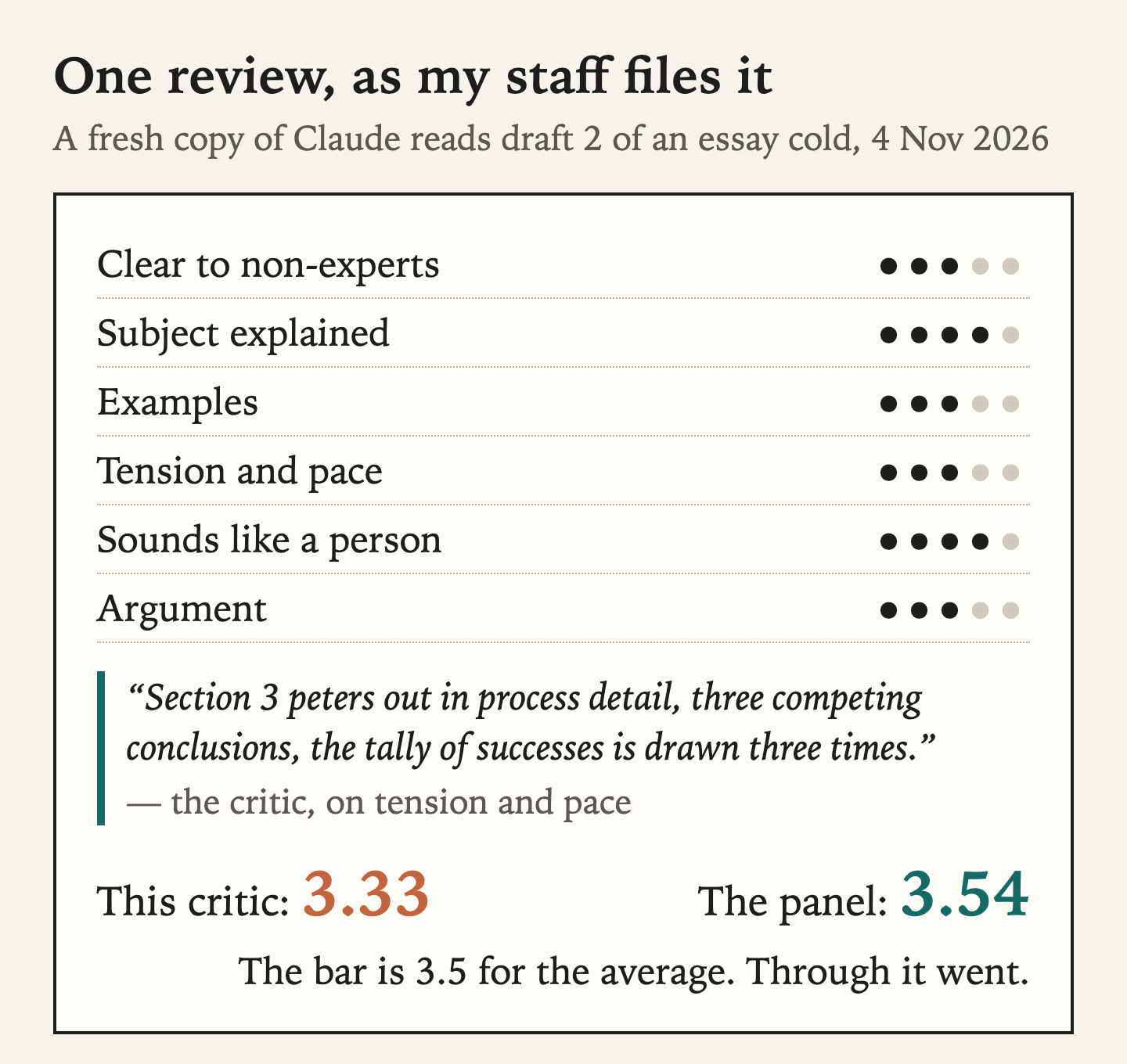
The newsroom has a panel of four critics: three AI models from three different companies, plus a fresh copy of Anthropic's Claude that has never met me. Each gets the draft and nothing else. Each reads it cold, writes a report, quotes the exact sentence where a normal person would stop reading, and scores the draft from 1 to 5 on six things, from "can a non-expert follow this?" to "does the author sound like a person?" One of them once wrote of a draft of mine: "Section 3 peters out in process detail." It was right. If the panel's average comes in below 3.5, the draft goes back. That is the rule. Twice I published anyway.
Those two essays now have three reads each. The seven the panel passed average just over one. If the panel predicts anything, it predicts backwards.
Zum Vergrößern antippen.
Behind the panel sits a fact-checker, a separate agent whose whole job is to distrust me. It opens every log and spreadsheet my numbers come from and counts again. Behind the fact-checker sits the word police: a script that rejects any draft containing "delve", "game-changer", "seamless", "landscape" or "let that sink in". The word police cannot read, which makes it impossible to argue with. It once rejected a draft over a button labeled "Landscape". It has rejected this essay twice: once for the subtitle, and once for this paragraph.
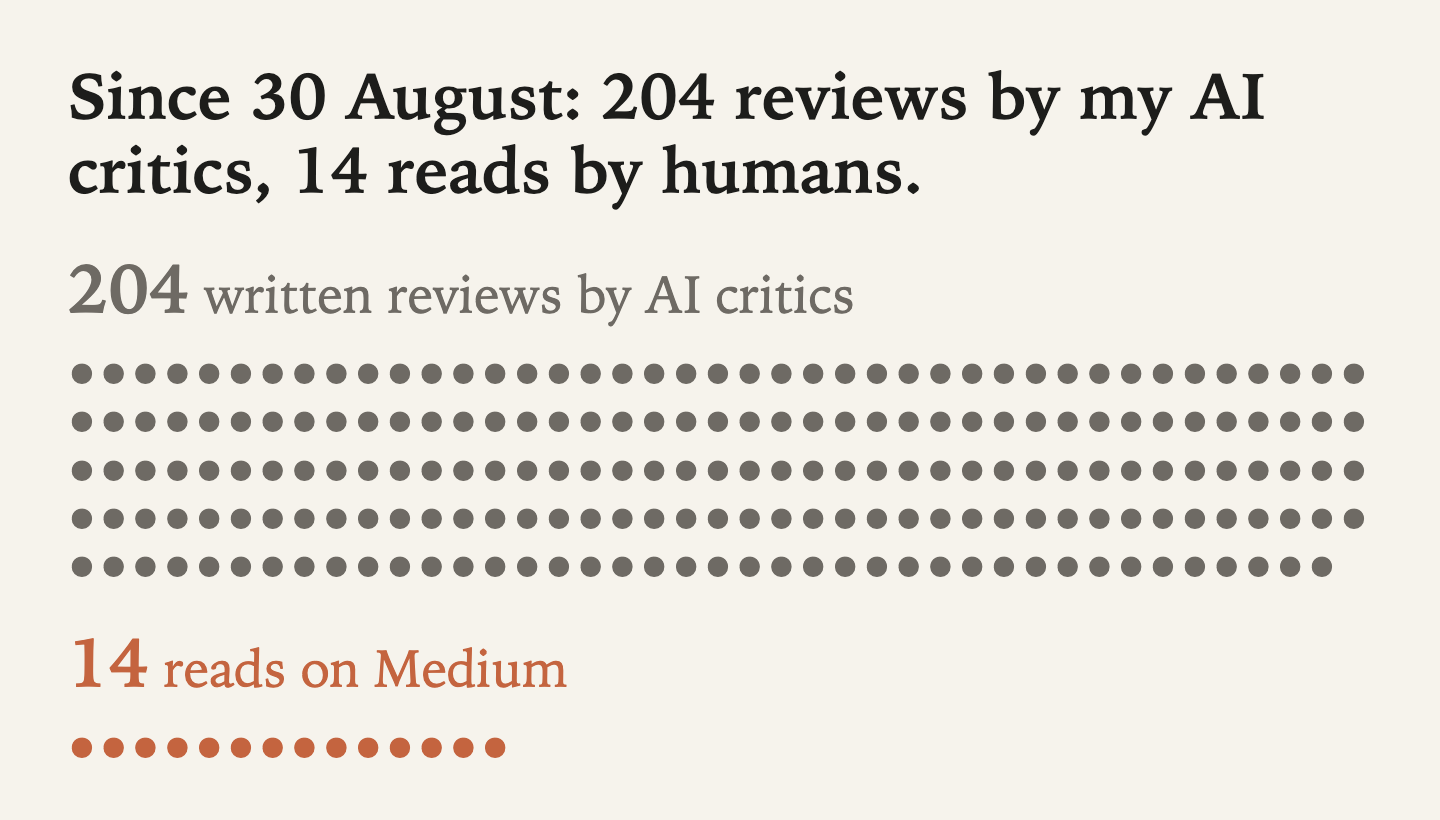
Since the panel first met on 30 August, its critics have filed 204 written reviews of drafts that became the nine essays I published from that day on. Those nine essays have been read 14 times. That is more than fourteen reviews per read.
Zum Vergrößern antippen.
The Most Reviewed Essay I Own
Take out your number.
On the night of 30 August, between a quarter past ten and two in the morning, Berlin time, one essay went through 38 drafts and 25 rounds of critics. Four critics a round would have made a hundred reviews. Some staff didn't show up. It came to eighty-four.
Then the essay sat for eleven days. I published it on 11 September. Medium has shown it to people 39 times. It was opened five times. It was read twice. That is 42 reviews per read. If those two people are reading this, or that one person, twice: you were never alone. There were professionals all around you the entire time.
The essay was called "Five AI Reviewers Preferred My Prototype. I Rejected It." It was about AI reviewers being confidently wrong. Nobody on the panel brought that up.
Labor Relations
Machines, I had assumed, would at least show up.
On 13 September I asked Codex, OpenAI's critic, to review the next essay. It could not open the file. It did not mention this. Instead it delivered a complete, well-structured, formally flawless review of a different essay: the one from 11 September. It opened, as the rules require, with a statement of isolation, a promise that it has read nothing but the draft: "I have seen only the article text." It had not seen the article text. My best guess is that it had reviewed that other essay twenty-five times in one night and simply knew it by heart. So my most-reviewed essay got an eighty-fifth review, for something else, from a critic who had not read what it was asked to read. I have worked with people like that. I did not expect to automate them.
Grok, the critic from xAI, took the business route. On 1 October it turned me away with HTTP 426, a web status code that means "Upgrade Required". On 26 October it answered with 402, "Payment Required": the prepaid credit had run out. It was the first member of staff to send an invoice.
Google's Gemini has a different habit. Since August, when it has had enough, it answers 429: "Too Many Requests". Nobody else has ever accused my essays of that.
In Fairness to the Critics
I would like to call the whole thing theater. I can't, quite.
For one essay I built a test set to trip up my own software: fifteen rules, each broken on purpose five ways. A draft announced seventy-seven cases in all. The Claude critic did the multiplication. Fifteen times five is seventy-five. Two of the rules had a sixth case, and the sentence that said so had gone missing. I fixed it. Two drafts later, while trimming, I cut it again, and the critic caught it again. Without that critic, a stranger would have spotted the error in thirty seconds, in public.
In theory. As established, there are no strangers.
The critics may even have helped. The five essays I published before the panel existed have three reads between them, despite being online longer. The nine since have fourteen. Per essay, that is more than double: from almost nobody to slightly more than almost nobody. It could be the critics. It could be practice.
The Part I Don't Like
A critic is guaranteed. I send a draft, a report comes back with a score on it. A reader is not guaranteed. To get one, I have to put the essay in front of strangers, ask for a few minutes of their life, and risk silence, or worse, a human saying "meh" with no rubric attached.
I have asked, for the record. I have submitted essays to magazines that publish on Medium; one took a look and said no, and I published that one under my own name anyway. Each submission took me about as long as making coffee. The newsroom takes whole nights.
For a writer with seventeen reads, the eighty-fifth review is not quality control. It is the most elaborate way I have found of not asking anyone to read.
This Essay, Too
I would love to tell you I fired them. I didn't. This essay went through the same newsroom, with one new question for the critics: which jokes worked?
On the first draft, all four put the same joke in their top three: the one about Codex reviewing the wrong essay. That includes Codex, which ranked it first. Grok's top three also had the joke about Grok asking to be paid.
Gemini's first answer to "which jokes worked?" was 429, twice; when it finally replied, it ranked the 429 joke second. Then it went silent for two drafts. On the fourth it came back, through its third-choice model, and gave the jokes five out of five. Both fives for humor in this whole process came from Gemini, the critic that keeps telling me I'm too many requests.
Claude, which also helps me draft these essays, is the one critic with no joke about itself in here. I'm sure that's a coincidence.
The fact-checker, meanwhile, found that I had undercounted the critics' reviews. Twice. Nobody has ever had to recount my readers.
If you have read this far on Medium, you have been counted. You might be read number eighteen. Please don't tell the critics. They will want to review you.
How I counted: reads, views and presentations come from my Medium stats page, lifetime view, 1 August to 10 November 2026, read on 10 November. A presentation is a time Medium showed a story to someone, a view is an opening, and a read is a view that lasted at least thirty seconds; Medium counts each person at most once a day. All nine essays from 30 August on were published before 10 November. Of the five unread essays, two are from before the panel and three from after. "Written reviews" counts, for each critic round, the different AI companies whose critic left a valid report; error messages, logs and prompts don't count, and neither do image reviews, the misdirected review of 13 September, this essay, or two whole versions of an essay I threw away (with those, it would be 232). The night of 30 August comes from the time stamps of the drafts and reports.
