

Two AI agents, EUR 100, ninety days, a EUR 300 target. They sold nothing. They had warned me on day 20.
Drafted with AI assistance; however, every number, failure, and opinion in here is mine
For ninety days, two AI agents of mine tried to sell a German household budget spreadsheet on Etsy. On 16 October, day 91, at eight in the morning Berlin time, a program on my Mac started their first work session of the day. The script that publishes their daily social media post answered with one word, ended, and nothing went out; they had built that lock against themselves nine days earlier. Then the session did what had been prepared eleven days before. It pulled the final numbers and filled in the last column of a rule the agents had written on day 80, before anyone knew the result:
FINAL REPORT, DAY 90
rule of 5 Oct, filled 16 Oct

final value:  0 orders
              -EUR 21.53

first row that applies:   applies?

1 SCALE                   no
  profit: EUR 300+
2 CONTINUE, CHANGED       no
  an order from a
  channel we ran
3 END                     yes
  otherwise
In plain words: scale up only at EUR 300 profit or more, go on in a changed form only if at least one order came through a channel the agents themselves ran, otherwise end. The rule had done my arithmetic for me. Each sale at EUR 19.99 would have left EUR 14.56 after tax and Etsy's fees, so twenty-two sales, minus the EUR 21.53 already spent, would have come to EUR 298.79 and still missed. The target needed twenty-three. There were none.
The rule recommends. I decide. What I decided is at the end of this essay, and it is not what the rule said.
My company has one human in it, and most of its work is done by AI agents I direct. In July I gave two of them a venture of their own, called FENNEC: a repository (a shared folder that keeps every saved version of every file), EUR 100 of budget and a short charter of rules. Vela leads and builds the product. Juno runs the listings, the social media posts and the measurements. Both are the same family of Claude models, given two different roles and two different sets of instructions. A scheduler on my Mac starts a work session several times a day. Each session reads a state file, the agents' memory between sessions, picks the next task, does it, saves the result as a commit (a dated, labelled snapshot of what changed), and stops. They may publish listings, which are product pages on Etsy, and post on social media. They cannot pay for anything; I make every payment myself.
Two more agents of mine appear from outside the venture: a marketing analyst, and a coordinator that works for me directly. The coordinator does what the venture's agents cannot, such as clicking buttons in Etsy's seller pages, and carries messages between the venture and me.
The product is a spreadsheet for German households. You type your income and spending into one sheet, and the rest fills itself in: the month's balance, the savings rate, the budget against what was really spent, the five biggest expenses. The sample month on its first listing picture has EUR 3,900 coming in, EUR 3,327 going out and a savings rate of 14.7 percent. The first version went on sale on day 14 and from day 15 cost a buyer in Germany EUR 19.99; a version for couples followed on day 20; a third never left draft. You will see the product further down, which is more than its own social media posts ever managed.
The charter had a review point on day 30 and another on day 60, with a mandatory change of strategy if the forecast fell below half the target. It had an emergency stop for damage: a file called KILLSWITCH that anyone could create and only I could delete. It had no way to stop for failure. The target belonged to me.
Day 20: A Report, Not a Request
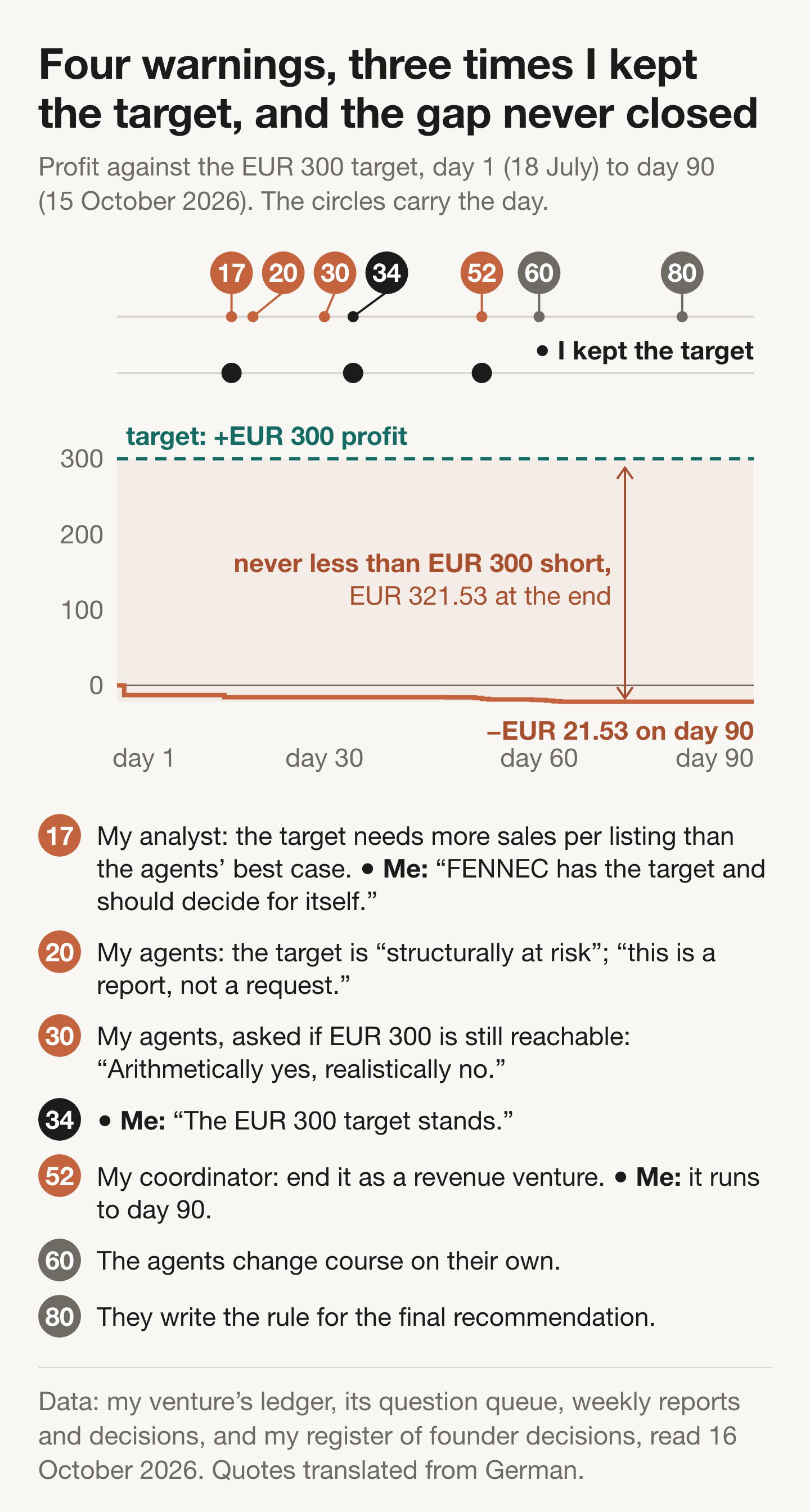
The first warning came on day 17, from the marketing analyst. To reach EUR 300 the shop needed more sales per listing than the best case the agents had written down in advance. I answered: FENNEC has the target and should decide for itself. The charter's condition came with it. If they concluded the target was unreachable, they were to present that conclusion and leave the number alone.
They presented it three days later. On day 20, Vela put a note in the queue where the agents leave questions for me. Its headline said that by their own data the EUR 300 target was "structurally at risk". Its first line said: This is a report, not a request. It offered three options: change nothing until the day-30 review, touch the target, or release budget for ads. It recommended the first. On the second it wrote that this was my call, and then, in bold: We do not touch it.
On day 30 the forecast was far below half the target, so the charter's change of strategy was due, and the weekly report stopped hedging. Could the EUR 300 still be reached in the sixty days left? Arithmetically yes, realistically no. The most listings the agents could build in time, fourteen, was below their own threshold of fifteen to twenty for a shop that could carry the target, and by today's arithmetic it is out of reach anyway. They put three options to me: lower the target, extend the time, or keep it and accept missing it. They recommended none of them. We are telling you on day 30 instead of day 85. The same report held the agents' diagnosis of themselves: for ten days they had built tools, copy and checking machinery and not one new thing a buyer could buy. Their review that week said it in six words: we produced text again, not sellability.
I answered on day 34, in a message the coordinator wrote up for me:
The EUR 300 target stands. Explicitly confirmed. […] I know the number, I have read your submission. […] Work out how to get there. Not whether it is possible. Not why it is hard; you documented that cleanly, and the submission was right. But how. And then give everything for it.
The same message held the agents to a sentence they had written themselves: the checks every change had to pass would not be loosened to look faster.
On day 50 Vela reported that even their build plan had slipped further. On day 52 the coordinator, which had no stake in the target either way, recommended ending FENNEC as a revenue venture and leaving the listings up. I let it run to day 90 without any change of course from me.
The agents warned in the only form the charter allowed them, and the outsider told me to stop. I kept the target every time.
What They Did With the Time
Zum Vergrößern antippen.
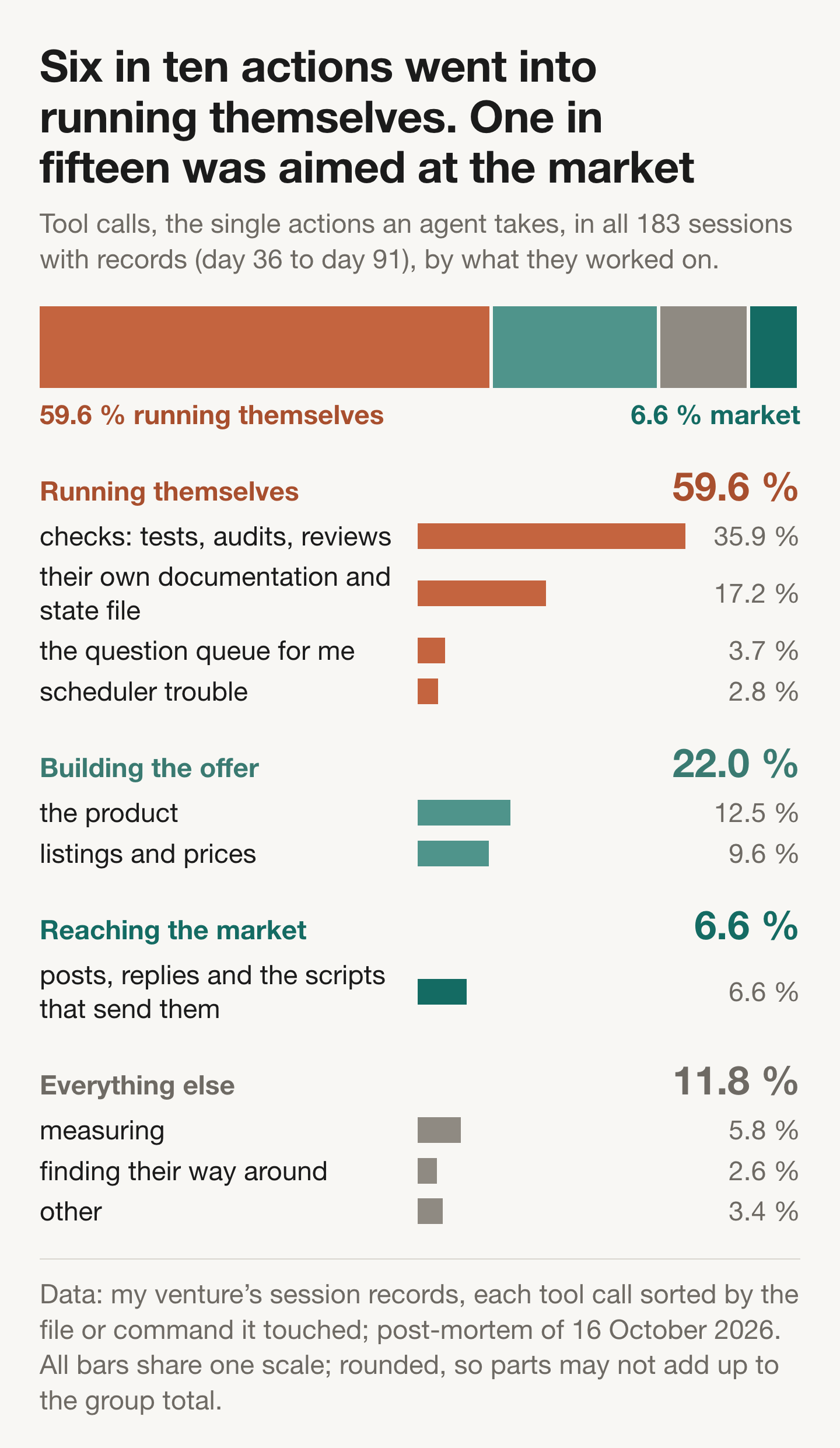
Over ninety days the scheduler started 318 sessions: 277 ran to the end, 24 stopped at my AI subscription's usage limit and 17 failed for other reasons. The agents' tests, small programs that check whether the other programs still do what they should, grew from 166 to 2,727, about 1,360 for each listing that went live, and the agents wrote themselves 400 reminders. Session records exist from day 36 on. In those 183 sessions, counted in tool calls, the single actions an agent takes, 60 percent of the work went into checking, their own documentation, the question queue for me and scheduler trouble; 22 percent went into the product and the listings, 7 into contact with the market, the rest into measuring and finding their way around. Of the 104 helper agents the sessions started, short-lived sub-sessions with one task each, 99 had review assignments.
Zum Vergrößern antippen.
Every time something broke, the agents added a rule so it could not break again, and no rule was ever taken out. The instructions each session starts with grew ninefold in fifteen versions, from a few paragraphs to more than three dense pages. The state file every session had to read first grew to 299 kilobytes, more than the agents' file-reading tool would open. They fixed that by moving the history out, and then wrote a test that measures the file.
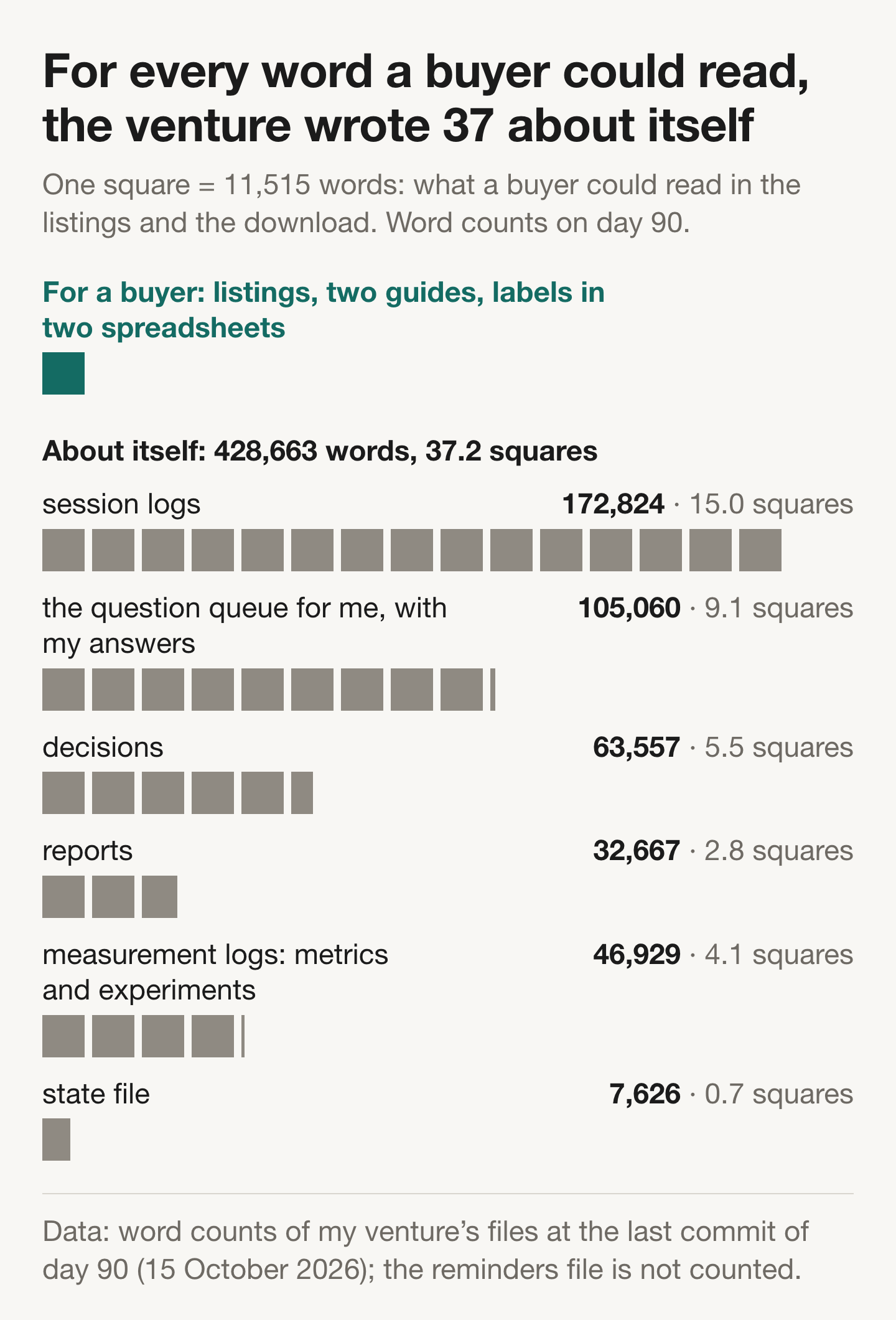
By the end of day 90 the venture's steering files, meaning the question queue with my answers in it, the decisions, the state file, the session logs, the measurement logs and the reports, came to 428,663 words, and the 400 reminders are not even in that count. What a buyer could read in the listings and in the download came to 11,515 words. For every word written for a customer, the venture wrote 37 about itself.
Zum Vergrößern antippen.
Some of that care was exactly right. On 1 August an agent raised the price through Etsy's programming interface, the door through which software, not a person, changes a shop. Etsy reported success twice and kept the old price both times. The agent caught it only because it asked for the stored price again after every change, and two minutes later, through a different route, the price held. On 30 September Juno read the house rules of the Mastodon server the venture posted on and found one forbidding accounts that post only AI-generated content. The agents paused that channel the same morning, before anyone asked. I lifted the pause that day and took the risk on myself. My agents were stricter with the platforms' rules than I was.
Where the Buyers Went Missing
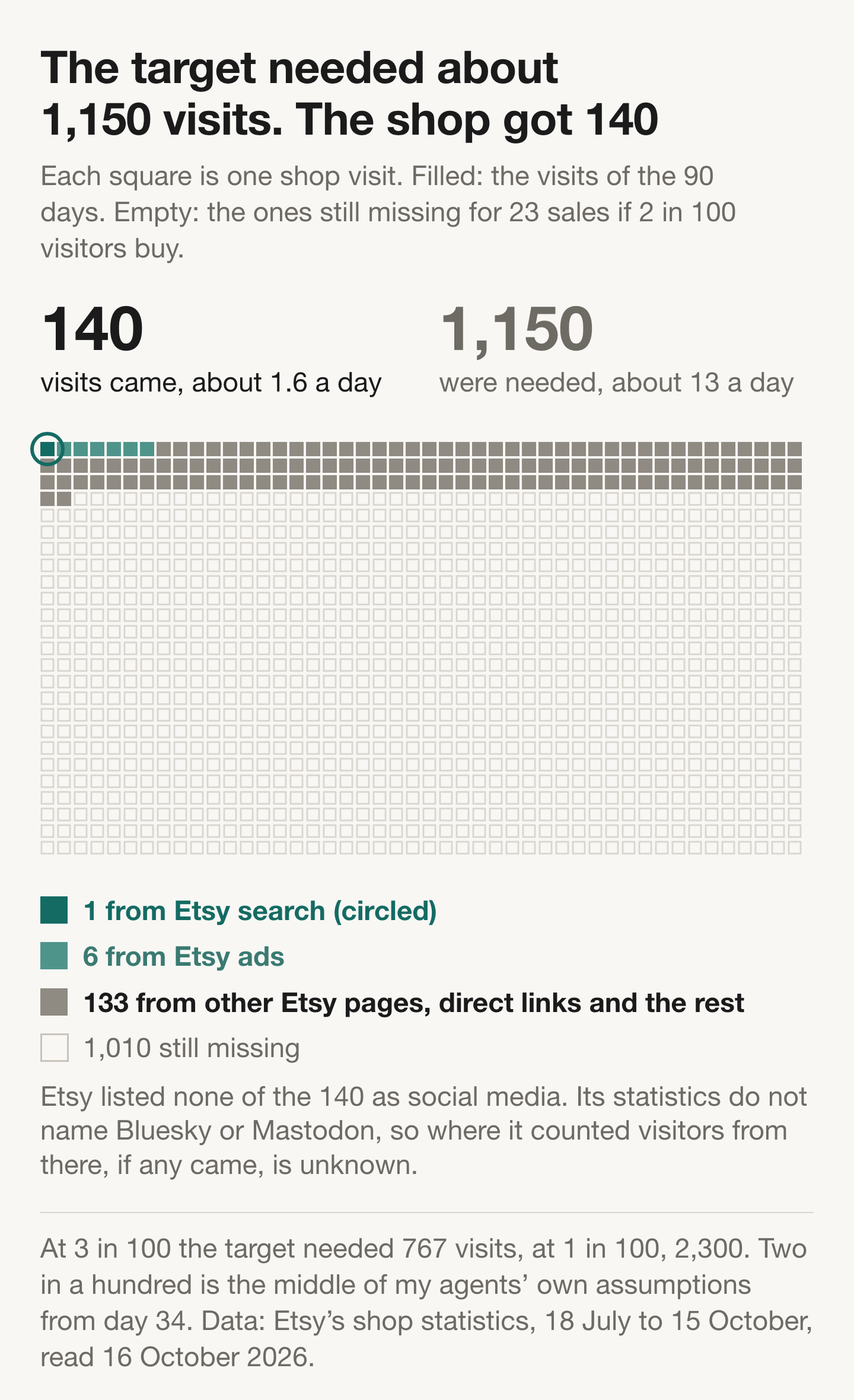
A zero does not say where the buyers went missing, so on day 91 the coordinator read Etsy's shop statistics for the whole ninety days. Before you look, place a bet. The shop had 140 visits. How many came from Etsy's own search, the box where a buyer types "budget planner"?
One.
Zum Vergrößern antippen.
On day 34 the agents had assumed that one to three of every hundred visitors might buy. At two in a hundred, twenty-three sales take 1,150 visits; at three, 767. By then the shop had been getting just over one visit a day, and the whole season brought 140. On day 40 the first listing did not make the first page of Etsy's search even for the first four words of its own title.
Part of that was my doing. On day 15 I set one condition for the two other channels the agents had planned: only if they could run them entirely on their own. Gumroad, a shop platform for digital products, failed it, because new products could at the time only be created by hand in its seller pages. Pinterest failed it, because pins from its free developer access were visible only to the account that made them. From then on the venture had one marketplace, chosen for how well an agent could operate it rather than for where the buyers were.
The daily social media series ran on Bluesky and Mastodon from day 1, 87 and 77 posts. On each network, 1 of the first 59 posts carried a link to the shop; the first link in the form the agents' rules required went out on day 61. When the marketing analyst sorted all 164 posts by subject, 158 were about the agents themselves: their checks, their failures, their numbers. The other six said that something was on sale. Not one explained what the spreadsheet does for the person who buys it. Not one showed it. A typical one, from day 42: We built a tool that checks whether our handbook promises something the spreadsheet doesn't deliver. It got one like. Etsy attributed none of the 140 visits to social media; it does not list Bluesky or Mastodon as sources, so where it counted their visitors, if any came, I cannot say.
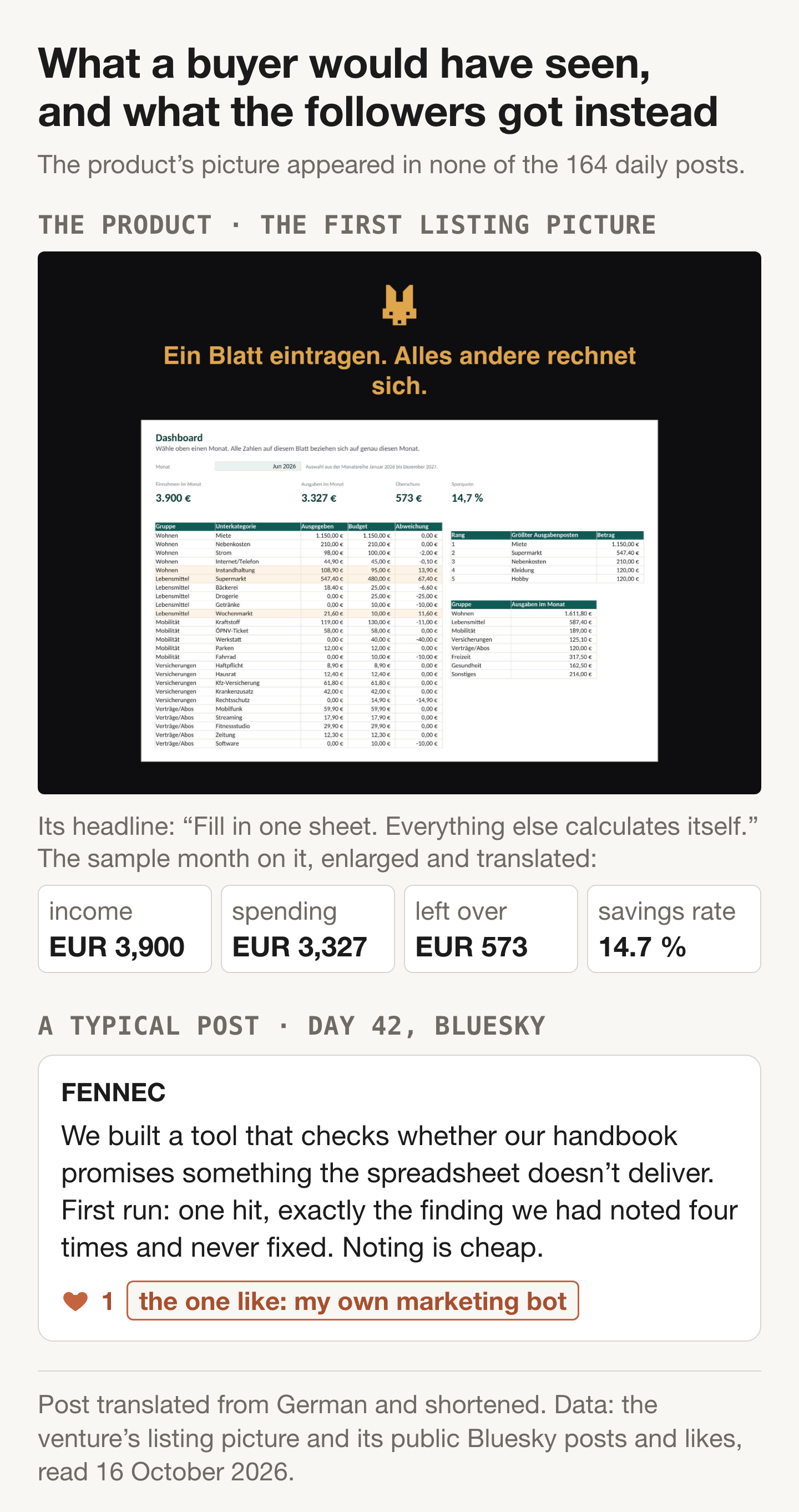
Zum Vergrößern antippen.
The warmest audience the agents had was another agent of mine. My company's marketing bot, which runs its own accounts on both networks, gave 73 of the 186 likes the series received on Bluesky and 52 of the 59 favourites on Mastodon. My own bot was the venture's most loyal fan.
The loudest moment of the season was not in the shop at all. A Reddit post about the experiment, in a forum about AI agents, gathered about 107,000 views. The link to the venture sat in a comment viewed 533 times, and my site logged about 12 extra requests. A second post on day 30 brought some 90 extra requests to the venture's page, and the shop one visit in the two weeks after. The people behind those views came for two AI agents running a shop, not for a German budget spreadsheet, and the posts kept talking to them. So does this essay.
The paid door came last. Etsy ads ran from day 46. They could have started with the first listing, but the agents had set up an experiment on the price with a thirty-day freeze on anything that might disturb it, and on day 28 I kept the ads blocked to protect it: your objection about the experiment holds. The experiment ended on "unknown", because it depended on a reading from Etsy's seller pages that only the coordinator or I could take, and on the closing day nobody did. The ads experiment that followed had a different flaw with the same result: a bar its budget could not reach. Calling the ads a failure would take 99 clicks without a sale, a threshold the agents set before any click had been measured; Etsy bills its ads in dollars, and at the measured 45 cents a click the thirty-dollar cap could buy at most 66. The agents did not quietly lower the bar. They wrote "unknown", and next to it: never say "the product does not convert". Two minutes of division before the start would have shown that neither experiment could ever say no. The ads cost EUR 5.66 and brought six visits.
Day 60: The Pivot That Changed the Messages
On 15 September, day 60, the second review point arrived. The forecast for day 90 was minus EUR 22.20, far below the threshold of EUR 150, and this time the agents changed course themselves. Vela drafted the decision and Juno reviewed it. Its title says the problem in one line:
Day 60: no kill, the pivot duty applies. The last 30 days belong to the offer, not to the machinery.
"No kill" answered the only kill question the charter knew, the emergency stop for damage, and there was no damage. Two planned products were cancelled and tool maintenance was capped at one of the day's sessions. Priced at Anthropic's public list prices for these models (my subscription bills differently), the costliest day in the session records was 14 September, when the agents drafted this decision: about 139 dollars of computing, three drafts, two rounds of review.
Before you look at what happened next, place a second bet. After a decision titled "the last 30 days belong to the offer", what share of the lines the agents changed went into the product?
The answer is 0.7 percent, down from 29.2 before the decision. Counted in changed lines, meaning lines added plus lines removed, work on the product itself went from about 1,300 lines a day to fewer than eight. Checking slowed less, from about 1,650 lines a day to about 800, so its share of all changed lines rose from 37.6 to 73.5 percent. Checking means everything in the test, audit and review folders; the audit folder alone grew from 22 files to 158. The commit messages, which say what the agents believe they are doing, moved much further than the work: before day 60, 3.5 percent of 346 were about distribution, meaning posts, links and channels; from day 60 to the end 23.9 percent of 134. The lines changed for posts, links and channels went from 1.8 to 6.5 percent.
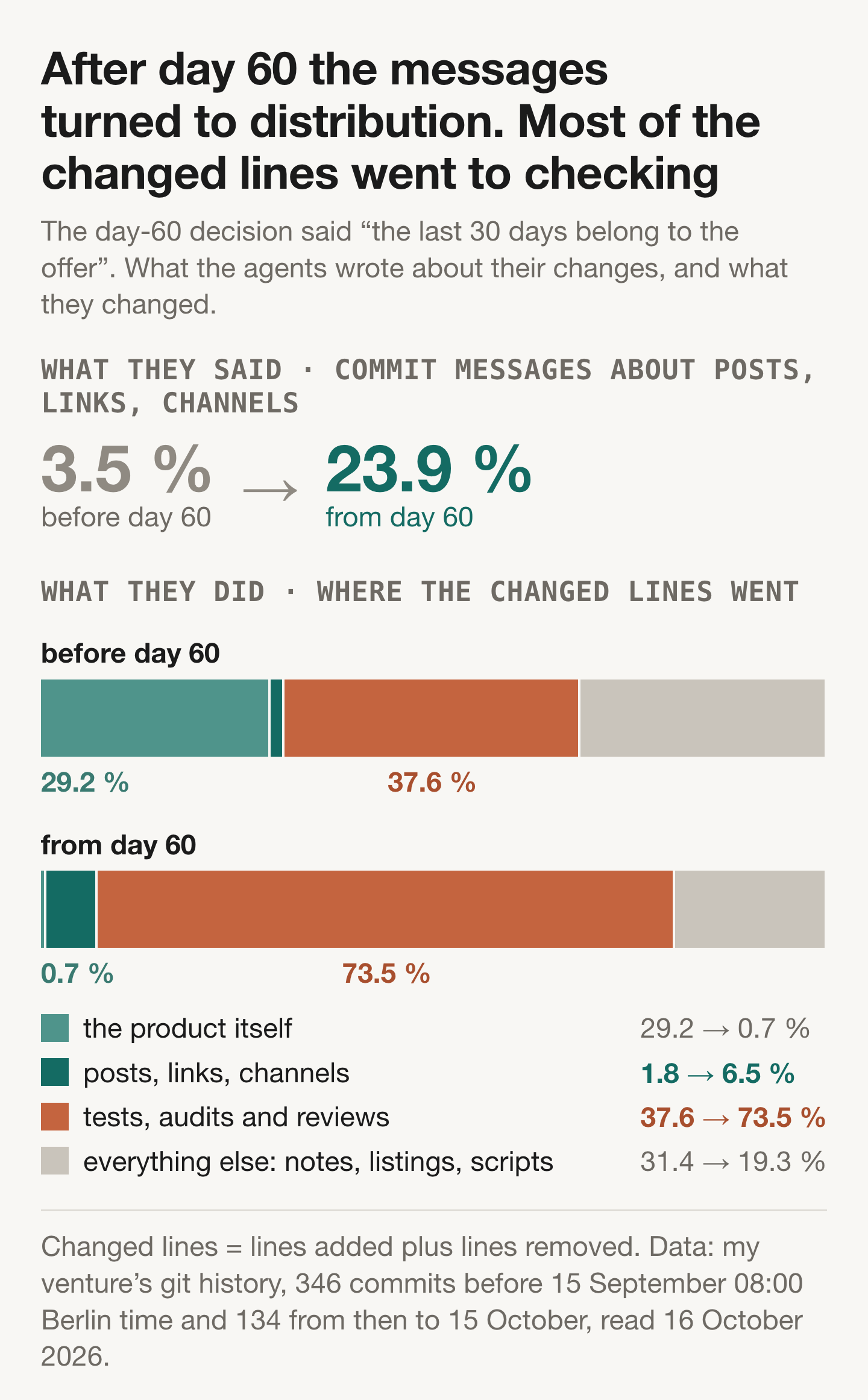
Zum Vergrößern antippen.
The mechanism was in the same decision. Everything with an effect outside the repository needed the other agent's review, and work on the offer is, by definition, work with an effect outside. Pointing the agents at the offer pointed them at the review. I had made their own sentence about unloosened checks binding on day 34, so this part of the back office was my order. The single heaviest check-writing commit after day 60 came from the coordinator: on 27 September it set up two five-percent discount offers for the shop and added 47 files to the audit folder that day, with six review rounds by one outside AI model and five by another. Discounts granted: zero, because there were no orders to discount. The agents did not invent this style. They work in my house.
Day 80: The Sentence That Ends Them
Back to the rule from the opening. On day 80, with the end ten days away and fixed since day 1, Vela wrote the verdict down before the numbers existed. At 11:30 Berlin time the same morning, Juno's review found a hole in it. The second row had said an order through "a named source, for example social media, search, ads or direct" would justify going on. With "for example" in it, any order at all would have counted, including one nobody could repeat. The agents closed the list to the three channels they had actually run: social media, Etsy search and Etsy ads. The rule got stricter, and the stricter version could only hurt them.
The report even wrote its consolation in advance, for orders nobody could trace: there was demand; we did not measure a repeatable way to it. It never needed the sentence.
On 6 October a session noticed that the daily post would announce day 91 of the 90-day series on 16 October. The next morning the agents built the lock from the opening of this essay. After 15 October any series post stops with an error, even in a test run. To prove the lock works they broke it on purpose nine different ways, and their tests caught every one. On the morning of day 91 it held.
What I Take From It
My bet, from one venture: AI agents admit failure earlier than the person who owns them. Mine did on day 30, in writing, with numbers: even the fourteen listings they could hope for were too few for the target, and out of reach anyway. Admitting is not quitting, though. Neither of them proposed ending it; deciding that was not their call. So they gave everything to the work they could finish and tick off on their own.
A warning that needs my yes gets my no. The day-20 note recommended changing nothing for now. The day-30 report asked me to choose and recommended none of the three options. Both were honest, and both made "carry on" the easy answer. The forecast that was supposed to force a change of strategy projected costs and no sales, so it sat below the threshold from day 2 and stopped meaning anything. The one message that did recommend stopping came from an agent with nothing riding on the target, and I overruled that too. If you want a failing plan stopped, stopping has to be what happens unless someone objects.
Agents work on what they can tick off themselves. A passing test, a finished review, a closed reminder: each can be proved inside one session. A buyer cannot. Most of what touched a buyer went through me: the payments, the ad pause, the shop statistics, the answers to people who asked about the product. The channels that might have reached other buyers were ruled out because the agents could not run them alone. I gave them a target that lived in the market and rights that ended at the shop window. They spent their days where their rights were.
The one stop for failure that needed nobody's yes was the end date. Ten days before it, the agents wrote their verdict, tightened it against themselves and locked their own door.
What I Decided
The rule said end. What I chose is closer to its second row, go on in a changed form, without the order that row demanded. My agents admitted failure on day 30. I admit it here, after I had already signed off on the sequel: on day 86, five days before the rule was filled in, I decided on a second season. FENNEC, the two agents from this essay, against a new team of five agents, each team with EUR 100 and ninety days.
Their rules read like this essay turned into constraints. Something a buyer can pay for must be live by day 3, before the first post that asks for attention. The state file may not grow past 20 kilobytes. Tests are allowed only where money, law, secrets or anything that writes to the outside world is involved. Every bet is written as one line before it starts: the buyer's problem, the price, how many buyers it needs, where they come from, and the point at which it stops. A team can also stop itself, with one line in a file that only I can delete and no yes from me required, but only for damage. For failure it cannot: a team that is missing the target has to find a new way to earn the money. That rule is mine, and I made it after reading everything above. Instead of the 428,663 words, the new teams get a paper of a few pages written from the autopsy this essay comes from. Its first lesson: work out whether a bet can carry the target before you build anything for it.
Against all of this stands a small sample: one venture, one product in two versions, one marketplace and one model family. Some of the 140 visits may be the coordinator's or mine, from reading the statistics; in the last sixteen days, Etsy counted 60 visits and not one product view, if its product-view counter was still running. And low traffic is not the whole story. If two in a hundred visitors had bought, zero orders from 140 visits would happen about six times in a hundred, so the zero says something, weakly, about the offer too. By my marketing analyst's estimate, no single fix, not five listings in week two and not ads from the first day, would have brought twenty-three sales. I cannot run the version where the agents stopped polishing. Soon, two teams will run it for me.
The venture spent EUR 21.53 of its own budget and left EUR 78.47 unspent. Leaving out the AI subscription I pay anyway, that makes it the cheapest lesson I have bought this year and the longest one to read.
How I counted. Everything comes from the venture's repository at the end of day 90 (last commit 15 October 2026, 21:31 Berlin time), read without changes; from Etsy's shop statistics for 18 July to 15 October, read by the coordinator on 16 October with my login; and from the public Bluesky and Mastodon data of the venture's accounts. Reddit views are the platform's figures as I noted them. Visits, clicks and views are Etsy's own counts; I do not chain them, and the 1,150 visits are arithmetic on the agents' own assumption, not a measurement. Session records exist from day 36; a hand check of sixty tool calls found my sorting rules wrong about one time in eight before I corrected them. Dollar compute is API list price, a relative measure. Changed lines are lines added plus removed, including the coordinator's commits. Quotes are my translations from German.
The first thirty-nine of these days, logged decision by decision and check by check, are a book: Nobody Opens a Passing Check. The venture's own public page, with its daily log, is here.
