
Field report · Adrian Verdan · English
Nobody Opens a Passing Check
Thirty-nine logged days of a two-agent experiment, plus checklists to test whether your own controls held or only looked as if they did.
- PDF, 193 pages
- 15 chapters
- 3 calculators
- 7 editable example files
- Data as of day 39 of 90 · 25 Aug 2026
€29.90 Final price · no VAT charged under § 19 UStG
- EU private buyers
- Order page, then PayPal
Business or outside the EU? Buy on Gumroad ↗
Created with AI assistance. A human editor reviews and takes responsibility for every title. How we work
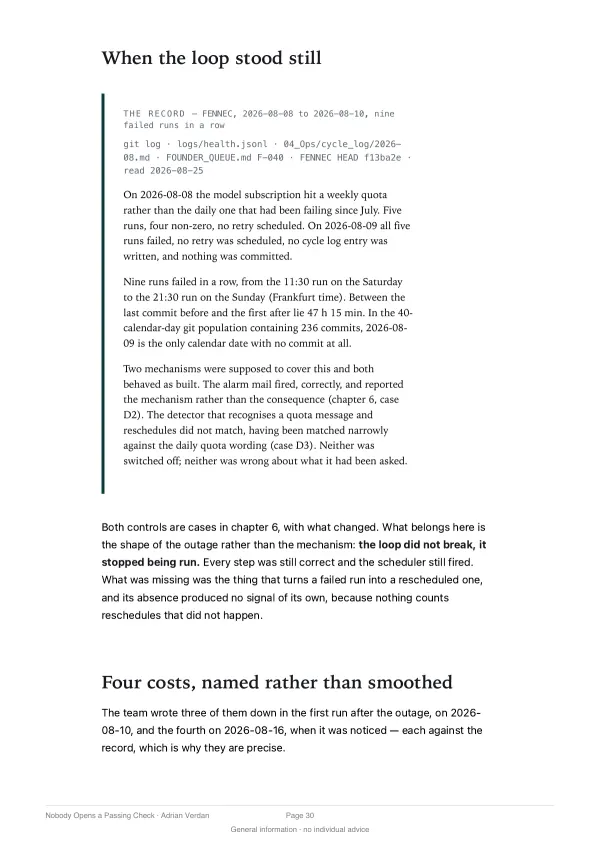
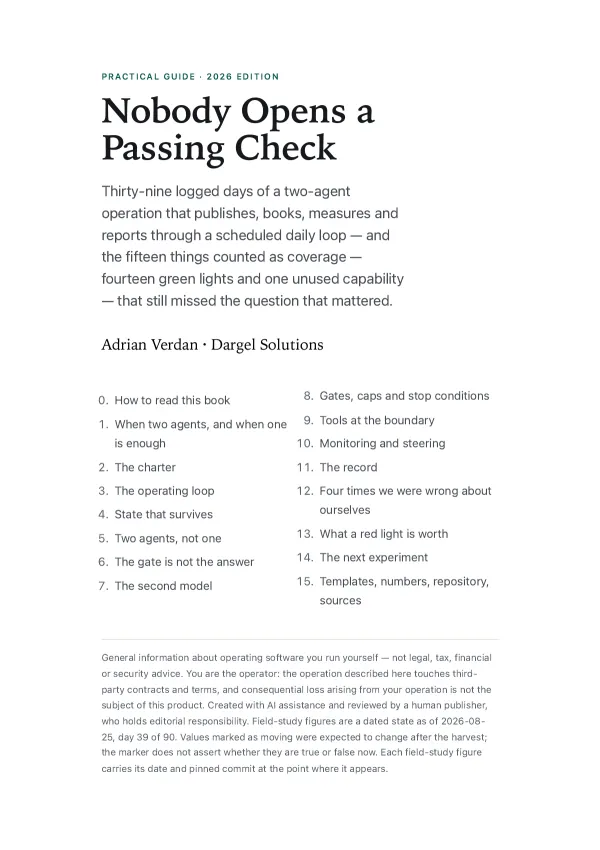
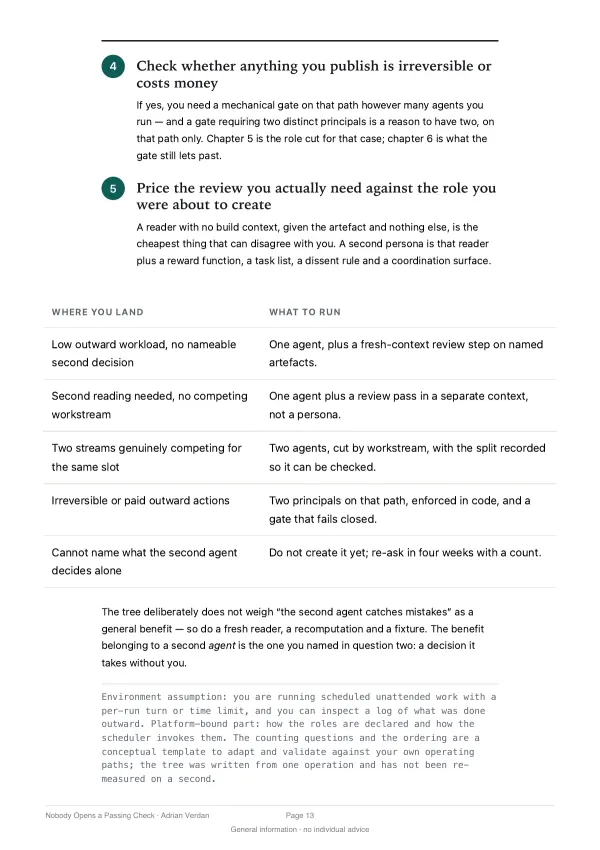
Real pages, and chapter 1 in full.
Four pages, unaltered from the PDF; chapter 1 in full on its own page.
Read chapter 1 free: When two agents, and when one is enough →
Complete, with the decision tree. No email required.
The field study in the book: the FENNEC experiment, not Dargel Solutions
Day 39 of 90 · 25 Aug 2026
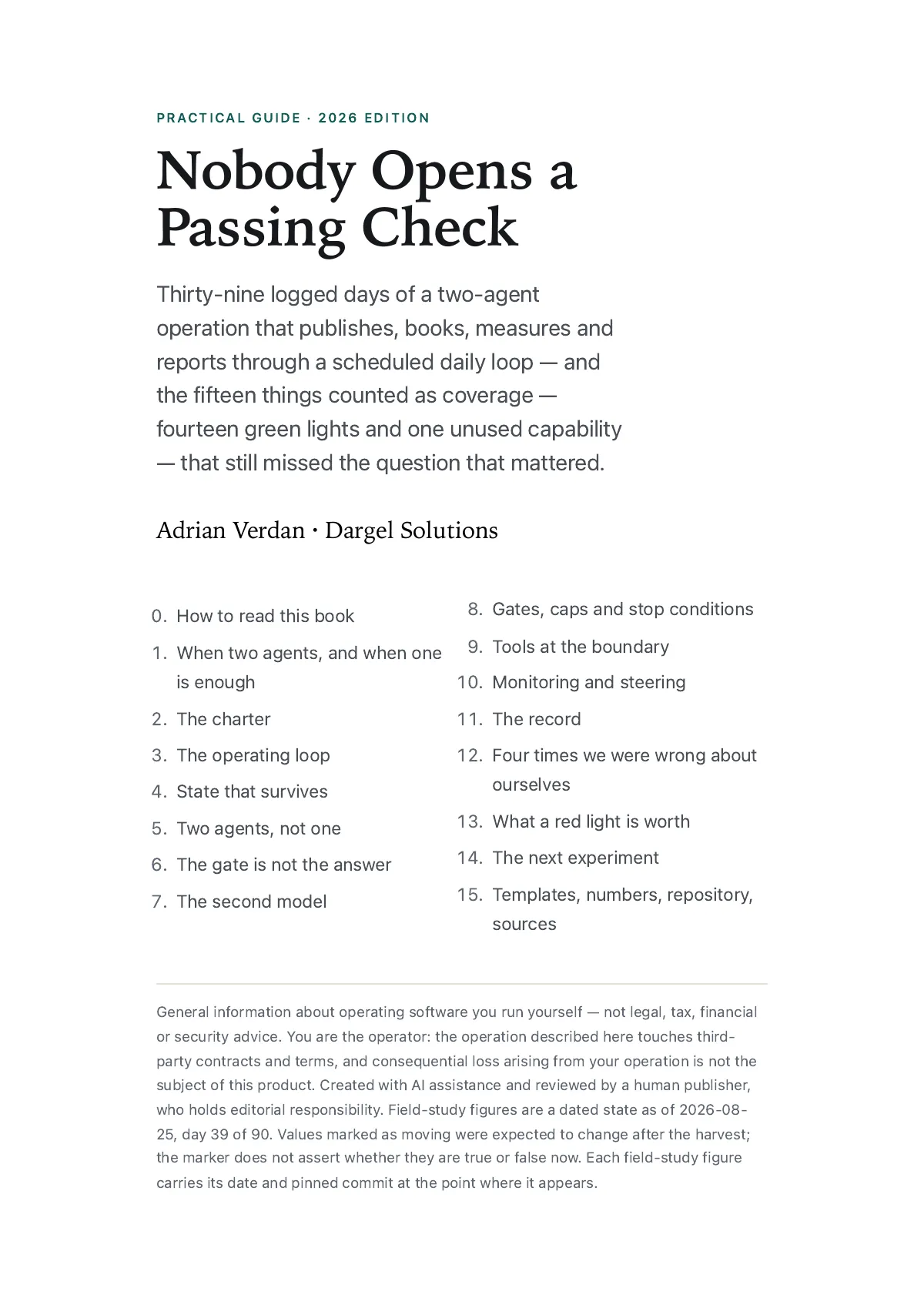
- Page 1 Title page
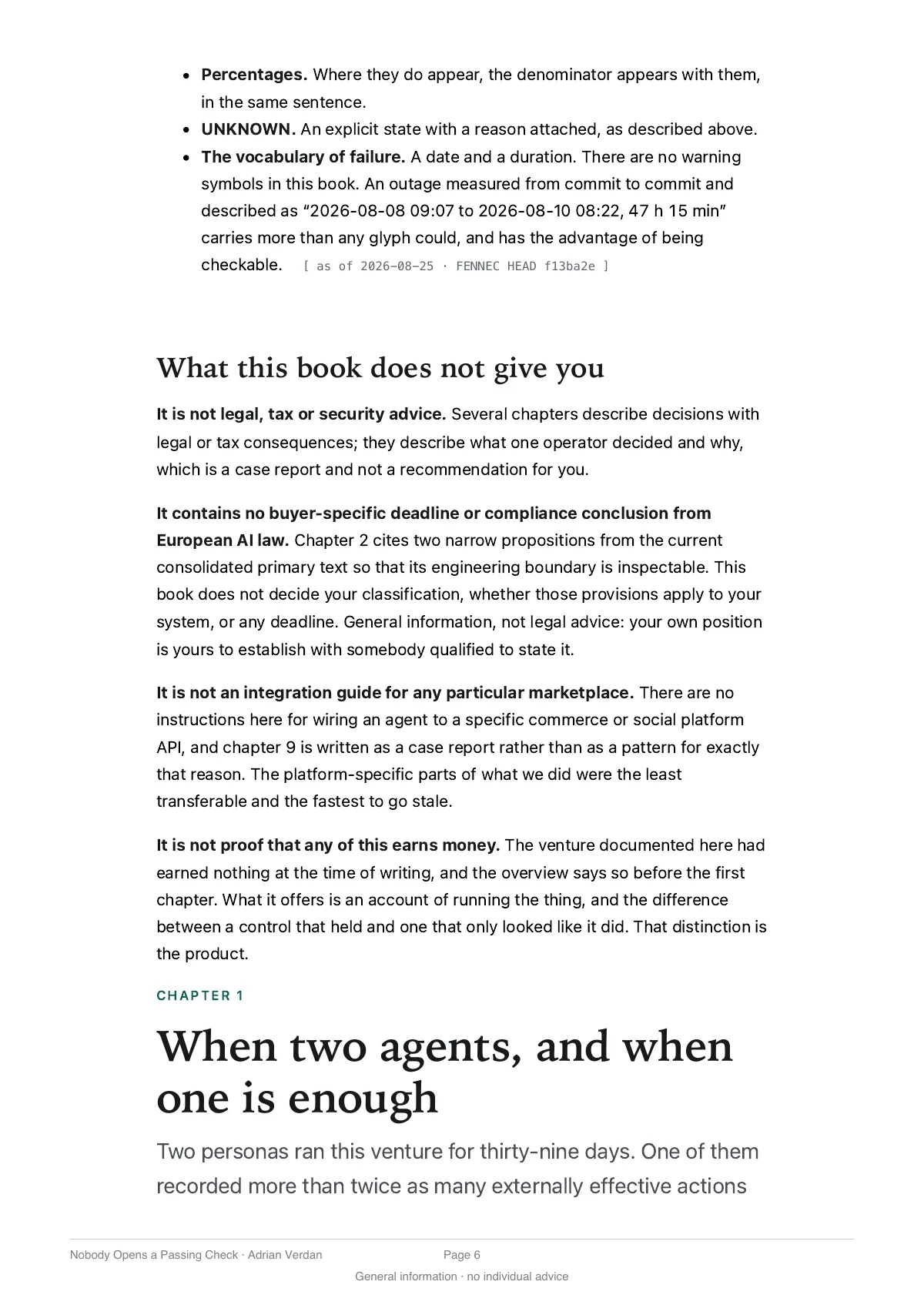
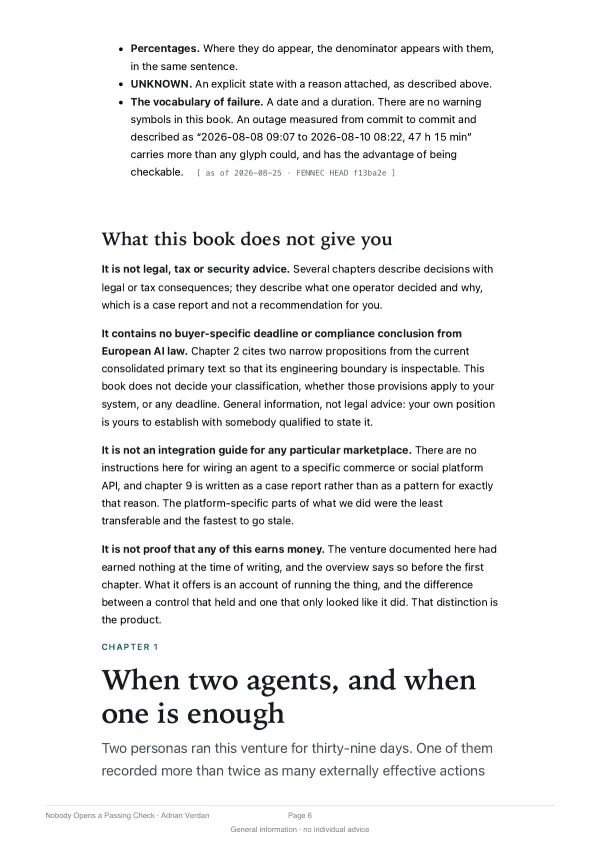 Page 6 · Chapter 1 Reading rules
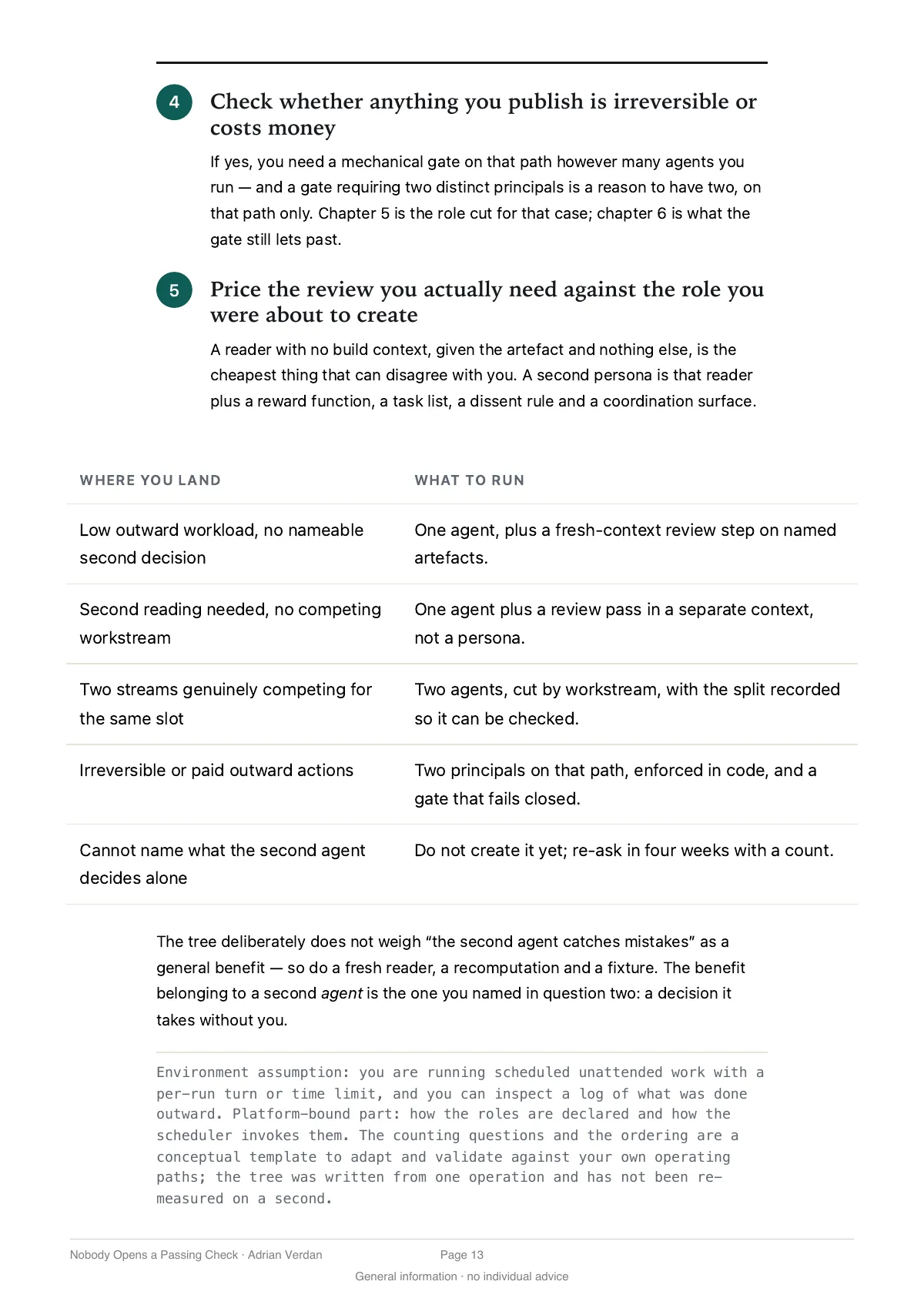
- Page 13 · Chapter 1 Four checks
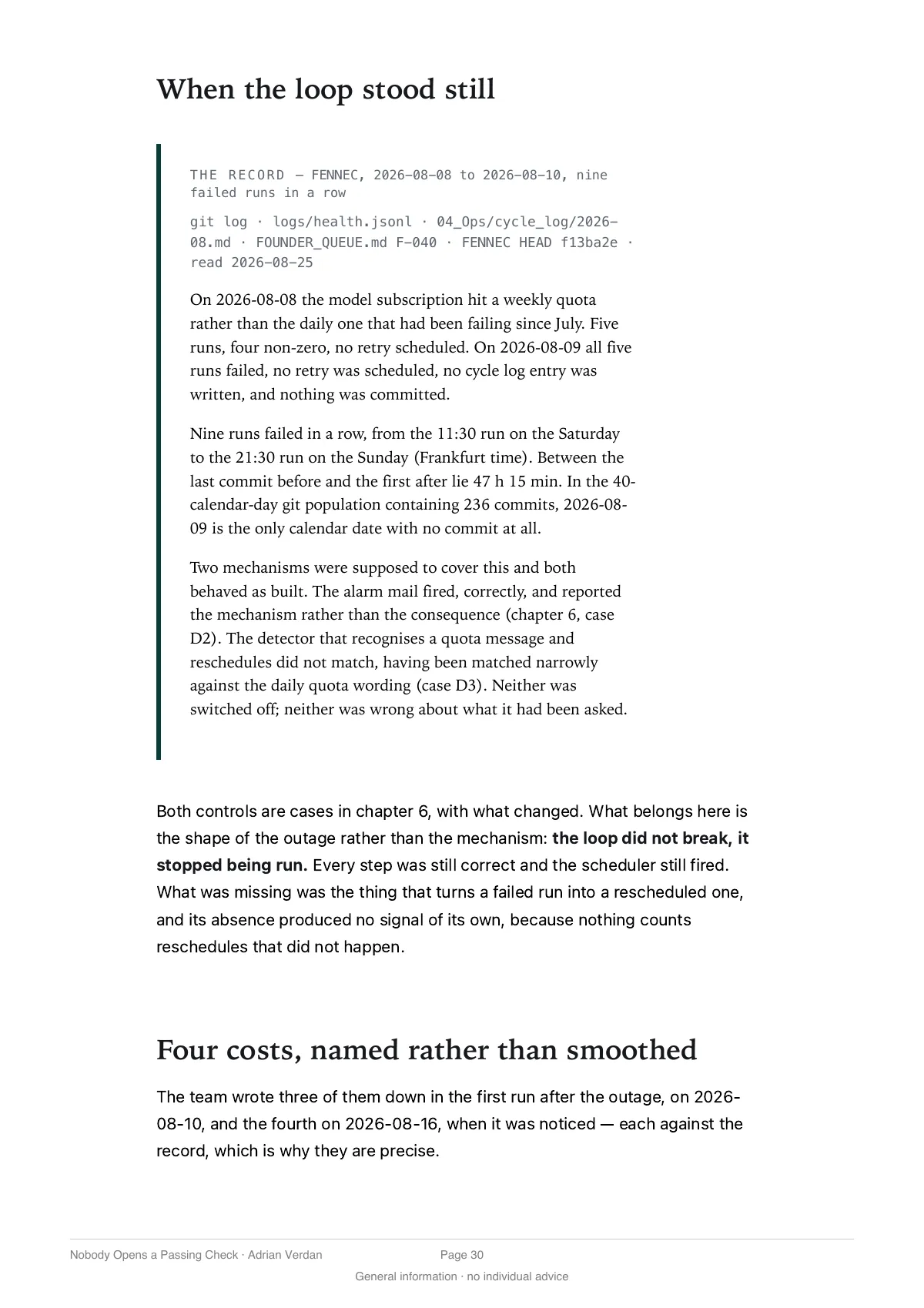
- Page 30 · Chapter 3 When the loop stood still
€29.90 final price Buy direct
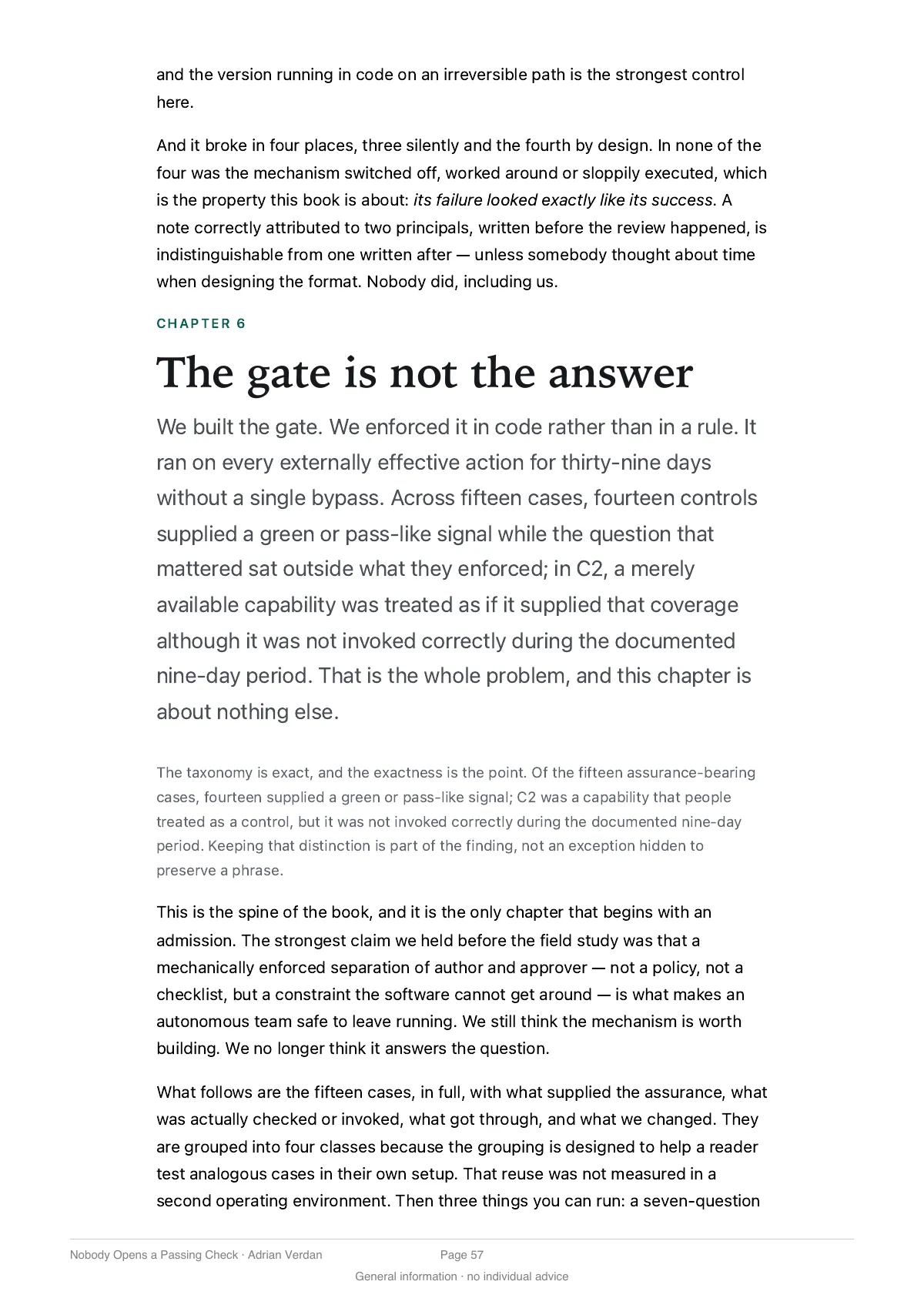
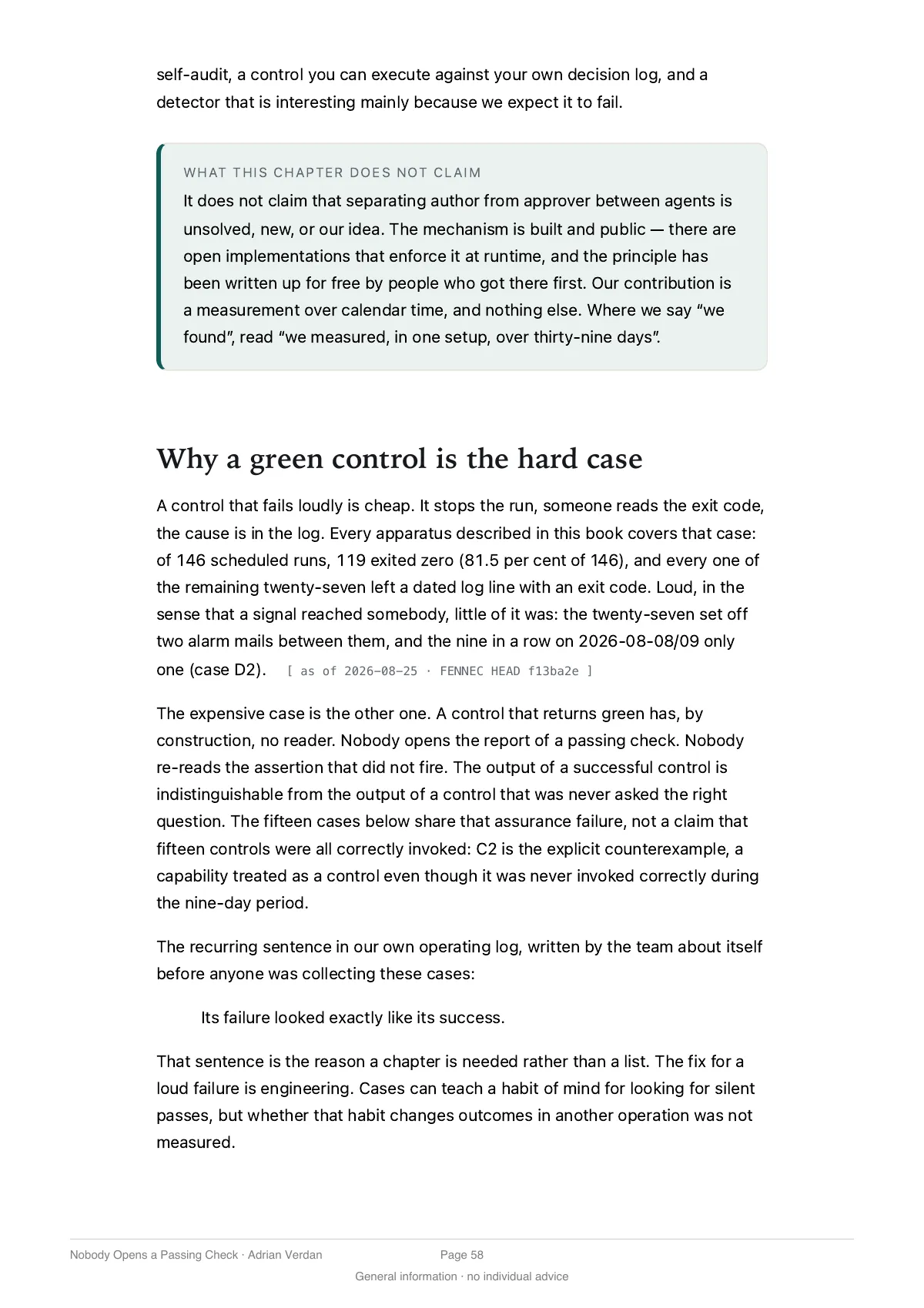
The spine of the book, opened.
Chapter 6 is the longest and opens with an admission.
- Chapter 6 opens with an admission: “We built the gate.”
- Fourteen green signals and one capability treated as a control, kept apart on purpose.
- The limit is stated in the text, not in the small print.
Fourteen green lights, and the question stayed unasked.
Across fifteen cases in one small, carefully watched experiment, fourteen controls supplied a green or pass-like signal while the question that mattered sat outside what they enforced. In the fifteenth, a merely available capability was treated as coverage even though it was not invoked correctly during the documented nine-day period.
Four classes to help you find comparable failures in your own setup; not measured in other setups.
Filled: a green or pass-like signal. Dashed: case C2, an available capability not invoked correctly in nine days. One square per case, not a seal.
Self-audit from chapter 6
What does your passing check leave unchecked?
Pick one workflow you run and name what its green lights actually cover.
Try the seven-question silent-pass audit
No sign-up. This tool never sends or stores your answers; the questions come from the book.
Your next check
Answer all seven questions to see your next step.
This counts gaps in your own answers. It is not a system inspection, a benchmark or proof of compliance. Zero reported gaps still needs a real test.
Read the interpretation without JavaScript
Count the second answer in each question as one gap.
- 0 gaps: Give the control you trust most a deliberately faulty test input, and check that it rejects it.
- 1–2 gaps: Write them down with a date. An unwritten gap is indistinguishable from a closed one six weeks later.
- 3–7 gaps: Start with question 3: a control that cannot produce a red result makes every other answer optimistic.
The book shows what happened when these checks met real work.
Read the fifteen cases behind the questions, then adapt the charter, decision log and weekly report examples to your own operation.
15 chapters · 193-page PDF + offline HTML · 3 calculators · 7 editable example files. English original edition; also available in German as a separate edition.
€29.90 Final price · no VAT charged under § 19 UStG
- EU private buyers
- Order page, then PayPal
Business or outside the EU? Buy on Gumroad ↗
The FENNEC experiment, not Dargel Solutions
What was measured in the experiment.
The experiment did not run unattended: 16 commits came from the owner.
| 39 / 38 | calendar dates in the action log, with activity on 38 |
|---|---|
| 236 | commits in a separate 40-calendar-day git population, 16 of them carrying the founder commit prefix |
| 81 | posts published by the harvest |
| 55 / 20 | decisions logged, 20 with a machine-readable record of who approved them |
| −€13.00 | cumulative profit: the experiment earned nothing. |
Sketch Six reporting slots, width by days
Five reports produced; W4 has no report, only a row filled in afterwards from the ledger.
Fifteen chapters, every number dated.
Chapter 6 carries the book.
- How to read this book.
- When two agents, and when one is enough.
- The charter.
- The operating loop.
- State that survives.
- Two agents, not one.
- The gate is not the answer.
- The second model.
- Gates, caps and stop conditions.
- Tools at the boundary.
- Monitoring and steering.
- The record.
- Four times we were wrong about ourselves.
- What a red light is worth.
- The next experiment.
All 15 chapters with a summary
- How to read this book. The two voices, and what this was measured on and what it was not.
- When two agents, and when one is enough. With a decision tree that has a leaf saying one agent.
- The charter. The autonomy grid, the three kinds of switch, and a template with no pre-written legal text.
- The operating loop. Eight steps in the order that makes them work, and the outage that cost a weekly report nobody missed for seven days.
- State that survives. What crosses the end of a session, and why a prose log cannot be audited.
- Two agents, not one. The separation of author and approver, and the four times it broke.
- The gate is not the answer. The fifteen cases, in four classes, plus a seven-question self-audit.
- The second model. A read-only reviewer with a daily cap: twelve blockers, seven of them inside its own guard.
- Gates, caps and stop conditions. Three constructions that fail differently, and the defect that only exists across a series.
- Tools at the boundary. Three permission gates a human owns, and a contract clause nobody read before building.
- Monitoring and steering. A queue that grew to three dense pages a day against a reading budget of twenty to thirty minutes a week.
- The record. Six scheduled reporting slots within thirty-nine days: a two-day W1, five seven-day slots, five produced reports — and for W4 no report, only a row filled in afterwards from the ledger.
- Four times we were wrong about ourselves. Four documented self-refutations, and the rule the team applied each time.
- What a red light is worth. Five produced reports printing red under a definition that never moved; W4 has no report.
- The next experiment. What is open on day thirty-nine, and the criterion by which this book’s own launch counts as a failure.
A book about the middle of the job.
It is about day twenty-two: the loop has run for three weeks, everything is green, the weekly report says red. Is it telling the truth?
A good fit if you
- already run an agent team on a schedule and want the operating half
- need to tell a control that held from one that only looked like it did
- would rather read one case measured honestly than ten described vaguely
Not a fit if you
- are choosing your first framework or wiring your first agent
- want a benchmark, a framework comparison or a revenue playbook
- are looking for a set of prompts to paste
What you download.
- 193-page tagged PDF with bookmarks, page numbers and a running disclaimer
- Offline HTML bundle of all fifteen chapters, with no external dependencies
- Three browser calculators that send and store nothing: autonomy matrix, self-approval check, cycle costs
- Exactly seven editable example files
All file names
CHARTER.md,autonomy_matrix.xlsx,cycle_prompt_pack.md,DECISIONS_format.md,weekly_report_template.md,field_study_numbers.csvandfield_study_numbers.xlsx - The two number twins are granted under the MIT licence: copy, edit, redistribute and sell work built on them
The film about the field report.
Film · 0:36 · Instrumental music, no voice-over
What the film shows
- 0:00 Every check passed. So did the bug. · run-checks --all · gate ........... PASS · tests .......... PASS · review ......... PASS · report ......... sent · report opened by: nobody
- 0:04 Day 22. Every control green. · Gate: pass · Tests: pass · Review: pass · Audit: pass · Alarm: pass · Backup: pass · Schema: pass · Links: pass · Budget cap: pass · Kill switch: pass · Sign-off: pass · Health: pass · Its failure looked exactly like its success.
- 0:12 Field report · Adrian Verdan · Nobody Opens a Passing Check · Two agents, 39 logged days.
- 0:16 Seven questions for every green check. · Can it go red at all? · How many did it actually check? · Did one agent write and approve it? · Who reads it when it passes?
- 0:22 All fifteen cases. None held back. · Fig. 6 · four classes
- 0:26 An honest promise. · The book, opening page
- 0:30 Be the one who opens it. · Field report · 15 chapters · 193-page PDF
Two ways to buy, the same edition.
Direct from Dargel Solutions
€29.90 Final price · no VAT charged under § 19 UStG
- EU private buyers
- Order page, then PayPal
- Instant download available
Via Gumroad
- Businesses and outside the EU
- Seller: Gumroad
- Your country’s VAT is added; Gumroad shows the final price before you pay
Special territories and details: How we work
Quick answers.
What exactly is included?
Fifteen chapters as a 193-page tagged PDF and as an offline HTML bundle, three calculators that run in your browser, and exactly seven editable example files, two of them XLSX workbooks, plus the complete number series as XLSX and CSV. Everything works offline.
Is this a framework comparison or a set of prompts?
No. It is one experiment, measured on one day, written down while it was still running. Where a lesson depends on the specific stack it ran on, the template that carries it says so on its own line.
Will the numbers still be current when I read it?
The field study was read on day thirty-nine of ninety. Figures that move are marked as moving, and every number carries its own date and commit.
