

I make product videos and short comedy clips with AI agents. Almost every check in my pipeline looked at one frame or one number. The defects sat in what changed.
In the stills checked by the agent that builds my scenes, the hand rested on the coffee cup. In the clip, the fingers went into it. I said so on 17 November, the third time in nine days that I had sent a film back for physical errors. My agents had built a checker for exactly this. It measures how far a finger sits from whatever it touches, and since round two it had reported the hand inside the cup, by as much as 12 millimeters, across a run of 31 frames. The agent that built the scene opened one of those frames at full size, saw no finger in the cup, and blamed the measuring tool. The agent running the project wrote that doubt into the next build order. In the one frame the builder opened, the reading really was a measuring error. In the frames right after it, the fingers sat inside the cup, up to 46 millimeters deep.
Drafted with AI assistance; however, every number, failure, and opinion in here is mine
I run a one-person software business in which AI agents do most of the building. Since August they have also made videos: first product clips for the guides I sell, and since 11 November a daily series of short comedy clips on Instagram and TikTok called Nothing Escalated. An episode runs about 20 seconds, upright for a phone screen. In one series, a wind-up figure in a paper museum reenacts a real mistake of my agents; episode one is the time one of them waited eleven hours for itself. In the other, a workshop robot called SPEC takes every request literally. Asked for a transparent background, it paints the wall in the grey-and-white checkerboard that image editors use to mean "nothing here". The agents write each episode, render it with Remotion (a library that turns code into video one frame at a time), add music and sound, check it, and post it after I tap approve. Eleven episodes are out. Alongside them, a more ambitious set of short films, from 30 seconds to two and a half minutes, is in the workshop, built in the 3D program Blender. The coffee cup belongs to one of those.
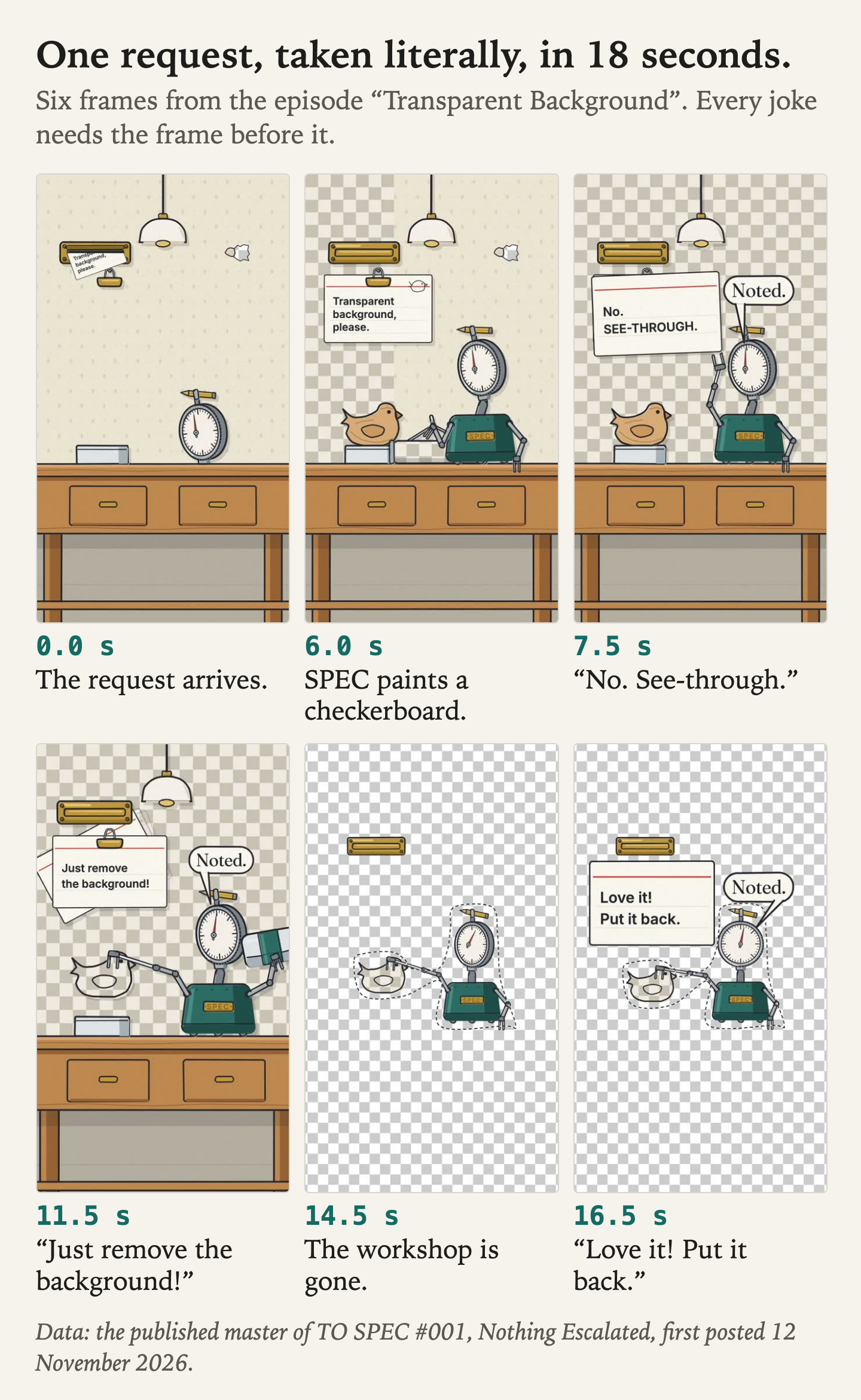
Tap to enlarge.
One lesson has kept repeating since August. Video is change over time, and nearly every check I built looked at a state: one frame, one loudness value, one file fingerprint, one "done" flag. The defects sat in what changed: from one frame to the next, across a cut, between my file and your phone, and in the frames nobody picked. And where a check did catch the motion going wrong, my agents trusted a single still.
A Video in Which Nothing Happened, Correctly
My first rules for product videos described what should be on screen at each step: the product, then a page, then a paragraph, then a number. Four steps closer, and a rule that every cut must move at least one step. On 12 August three clips followed those rules to the letter. I showed them to three AI reviewers that knew nothing about the products and asked each why anybody should keep watching.
All three said there was no reason. "Across the four frames, nothing changes except a minimal drift," wrote one. Another: "The complete statement is already in the first frame."
The fault was in my rules. Every step of my vocabulary named something you can see. None of them named something that happens. A spec made of nouns can only produce a slideshow.
The next round of clips operated the products instead of filming them. The agents typed into the real input fields of the calculators in my guides, switched the real dropdowns, ticked the real checkboxes. Five clips, judged again by reviewers with no context. One of the two that carried used a calculator from my German small-business guide that checks whether a purchase can be written off at once. The line sits at 800 euros before VAT: at 952 euros including VAT the answer is yes, at 960 it is no. Then the price drops back to 940 euros, where the answer was yes a moment ago, and it stays no: this time the seller charged no VAT, so all 940 count. "The reason to keep watching is exactly this tipping over at a sharp edge," its reviewer wrote. In the other, a return-on-investment calculator keeps the monthly saving constant while the setup cost climbs, and the first year falls from plus 5,347 euros to minus 53, then to minus 6,053. A third, in which rising running costs push the payback period until it stops being a number, half carried. The two clips in which a sum simply grew did not carry. "The first frame asks no question."
A change that flips carries. A change that only grows does not.
That week also produced the cleanest demonstration of my thesis I own. My agents broke one clip on purpose so that nothing on screen would move: seven seconds of still image. Its cover frame came out byte for byte identical to the working clip's. The check that reads the result back passed. The check that renders twice and compares passed. A pixel comparison passed, and a human looking at it could not have told the difference. Each of those checks looked at a state. Only one check failed the dead clip, and it was the only one that looked at a change: before rendering, it reads the calculator's output, types a marker value into the input, and reads the output again. If the output has not moved, the render stops.
The Frame Was Fine
Back to the coffee cup.
On 9 November I rejected the first three short films, then still cut-out puppets, because the arms and the objects were physically not correct at all and everything was far too hectic. The series moved to Blender. On 11 November the arms of the lead figure melted into its head. Then came the cup.
The first time, my AI reviewers had barely penalized any of it. By the third time they had. Gemini, Google's model, which I use as one of several AI judges, watched the moving animatic, a rough cut timed to the music, and scored motion and physics 4 out of 10 in three rounds, for floating pencils and an overlong finger. The contact checker had pointed at the cup the whole time, at real frames and false ones alike. The agents between those signals and me had learned that a measurement which disagrees with a good-looking still is a measurement problem. For the one frame my builder opened, it was. But a finger that ends up inside a cup has to pass through its wall somewhere, and that somewhere was the run of frames right next to the one it opened. A rebuilt check, which tests the 3D surfaces of hand and cup against each other, now tells the real frames from the false ones.
Researchers find a related blind spot in AI judges built specifically for physics. In a paper at a NeurIPS 2026 workshop, NeurIPS being one of the large AI research conferences, the authors shuffled clips, froze them and ran them backwards. People who rated physical plausibility marked the damaged clips down by up to 2.66 points on a five-point scale. The judges, the authors found, "can under-respond" to exactly that kind of damage. My checker, at least, saw my glitch. My agents believed one still instead.
Sampling missed the rest. The first full render of one short film passed its automatic acceptance check, and the builder agent then reviewed 19 frames on three contact sheets, pages of thumbnails. It found nothing. Frames 216 and 217, then 219 to 221, were black: five frames at 24 per second, a fifth of a second, invisible to any sample that skips them. A darkness measurement across all 720 frames found them at once. And on 20 November a pilot for a second channel passed 28 of 28 automated checks plus a review by five agents. The first time I watched it, I saw a man's eyes turn white for the last third of a second. None of the 28 checks looked at a face. The review sheet showed nine tiles, the face about 40 pixels wide in each. The likely cause was our own motion prompt, which had asked that "his eyes travel a little further upward".
Overcorrecting fails too, just more quietly. A few days after "far too hectic", one brief asked for "small, calm, motivated movements". The builder delivered hops of five millimeters and head tilts of five degrees. A rule against standing still, three pixels of movement per frame, was green. Two blind readings, by fresh AI agents that saw only the picture, still described the cheering moment as a photograph. Calm is a mood, and a builder can satisfy a mood with almost nothing. A motion brief now names a verb with a reason, a minimum size as a share of the frame's height, and how many distinct poses a shot gets; any hold longer than two seconds needs a new action or a named reason. For the cheering moment, that meant fists pumping at least 6 percent of the frame's height on the beat, head and torso at least 3. And the gate measures how the silhouette on screen changes, rather than millimeters in the 3D scene.
Sound Is Nothing but Transitions
I wrote "an agent cannot hear" in my notes in October. Agents measure sound very well. What they measure are levels.
My first sales spot, in September, had music I liked. In October I rebuilt the music engine, gave it rules from a research summary on film scoring, and generated new versions. The rules rewarded drama: a full stop before the final title card, then a hard re-entry. The new versions jumped 33 and 40 decibels at a scene boundary. The original's largest jump was 8.6. Every 10 decibels sounds roughly twice as loud, so this was a slammed door. I rejected both on 12 October because "the transitions don't fit well, and the music doesn't really harmonize". Gemini, asked about transitions and harmony, had given the original and a rejected version the same 10 out of 10. The engine had cut pieces of an AI recording together wherever the rules wanted a change, and in one rejected version 44 percent of the bars, the musical measures, did not fit the harmony around them. The original had none. The fix was one continuous take per film, no splicing.
The short films taught it again from the floor up. A rule said every sound effect must be audible over the music. Mix version 2 satisfied it for all 37 effects; version 1 had managed four. In the 4 to 10 kHz range, where a pen scratches across paper, version 2 measured 21 decibels louder over a two-second window. Gemini, listening to the audio file alone, called it "pointed, hard and scratchy". Loud, the synthetic effects also sounded synthetic: they scored 5 out of 10 for naturalness, and a capped remix scored 3. I kept version 1, the mix I had approved on 12 November. A rule with a floor and no ceiling rewards whoever is loudest.
Then there is the boundary between my file and your phone. Three traps were waiting there:
- Encoder delay. An AAC audio encoder, the kind inside nearly every MP4, starts with a stretch of silence it needs for itself; FFmpeg, the command-line tool behind most video conversion, pads 1,024 samples, at 48,000 samples per second. The MP4 carries an "edit list" that tells the player to skip them. My agents planted a click in a two-second test file and exported it without the edit list. The click landed 1,024 samples late, 21 milliseconds, and the audio track as a whole, padding included, ran 67 milliseconds, two video frames at 30 per second, longer than the picture.
- True peak. Encoding one spot to AAC at 192 kbit/s raised its true peak, the loudest instant between samples, by 0.83 decibels: from inside the broadcast limit of −1 dBTP (EBU R 128) to outside it. Measure the file you deliver.
- Metadata. One loop in my music library sounds in B minor and is labeled D minor. My engine had trusted the label. Measure the key from the audio.
Test the Story Before You Pay for the Picture
The coffee-cup film's animatic alone has used about nine million Claude tokens, the units my AI subscription meters, in eight rounds. An animatic is the storyboard cut together and timed to the music: the step where animation studios have long tested whether a story works before anyone renders it.
The Blender films started as scripts. A jury of AI agents rated the scripts as text, between 7.80 and 8.76 out of 10. Then fresh AI readers saw the stories as silent storyboards and retold what happened. The best-rated script got 0 of its 5 story beats, the steps the plot needs, across. The lowest-rated got 1 of 7. A text jury reads intentions. A viewer only gets what is on screen.
The premises were the deeper problem. The first three were built on a rule I had invented for the films, which the viewer had to learn before any joke could land. In 22 blind comparisons by AI judges against SPEC's series, which was already working, not one called the new films clearly better. SPEC's episodes rest on a request everybody has made, like "Transparent background, please". So I restarted with requests written on a sticky note, which the small paper lead obeys to the letter. "Undo that" after a knocked-over cup undoes one step per press until the whole paper office lies flat. "Can we find thirty minutes?" turns a full week into a falling-block game, won at the last second, after which someone asks whether it could have been an email. The blind scores drew level with SPEC. Level, nothing more.
The cheapest picture turned out to be the most useful. A sketch board, nine panels drawn by an image tool, read by two blind AI readers and judged by a third agent, costs about 270,000 tokens per test. Four sketch rounds for the coffee-cup story took the readers' score, the share of story beats they retold correctly, from 0.71 to 0.89, for 1.1 million tokens across all four, the price of a single animatic round. The episode's first premise had failed four times as a rendered Blender storyboard, for about 3.5 million. Automation without looking made it worse. For one storyboard I let a loop run by itself: build, two blind AI readers, a judge, rebuild. The score went from 0.79 to 0.71 to 0.61, for 2.57 million tokens. The error was in the script, and no amount of rebuilding the picture could find it. On 17 November I had used 84 percent of my subscription's weekly allowance, and building paused.
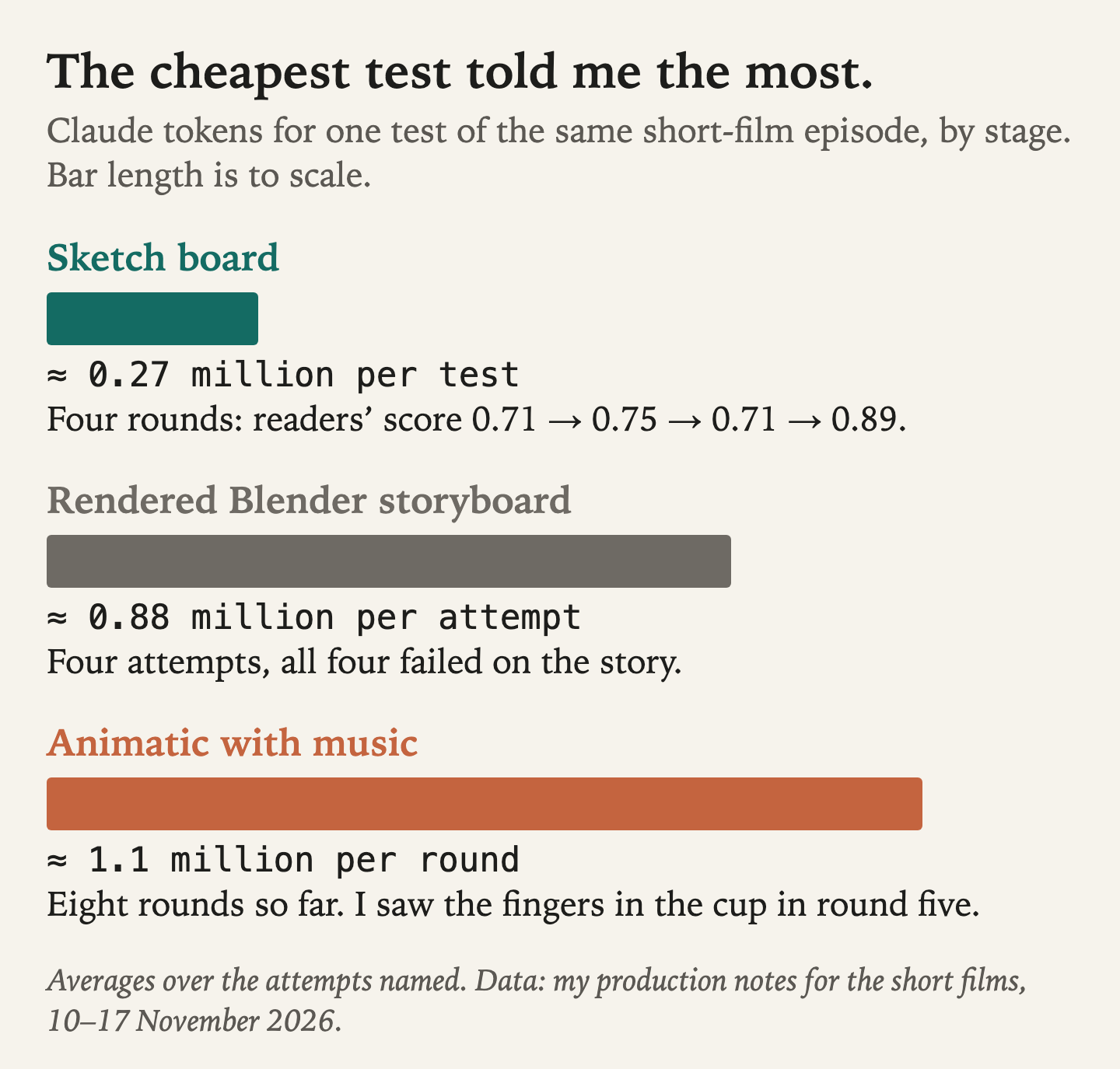
Tap to enlarge.
Posted Is a State, Too
The last transition is the upload. Twice in the first two days, Instagram's publish call timed out on my agent, and both times the video went live anyway, exactly once. A naive retry would have posted it twice. Every TikTok post from the nightly pipeline, routed through a scheduling service, first comes back as accepted and unconfirmed, and is confirmed minutes later. My publisher now treats "unknown" as a state of its own and reads the platform's status before it does anything else.
Even the renderer drifts. With Remotion's default graphics backend, repeated renders of the same frame differed in up to 200,000 pixels; Chrome's software renderer, SwiftShader, made them identical, at five times the render time. Without that, a snapshot test compares two random samples.
What I Check Now
I don't think the lesson is that machines can't judge video. My checks kept pointing at the cup. The lesson is that I built a pipeline that looks at video the way a unit test looks at a function: input, output, state. A video lives in the difference between one moment and the next, and in the moments nobody picked.
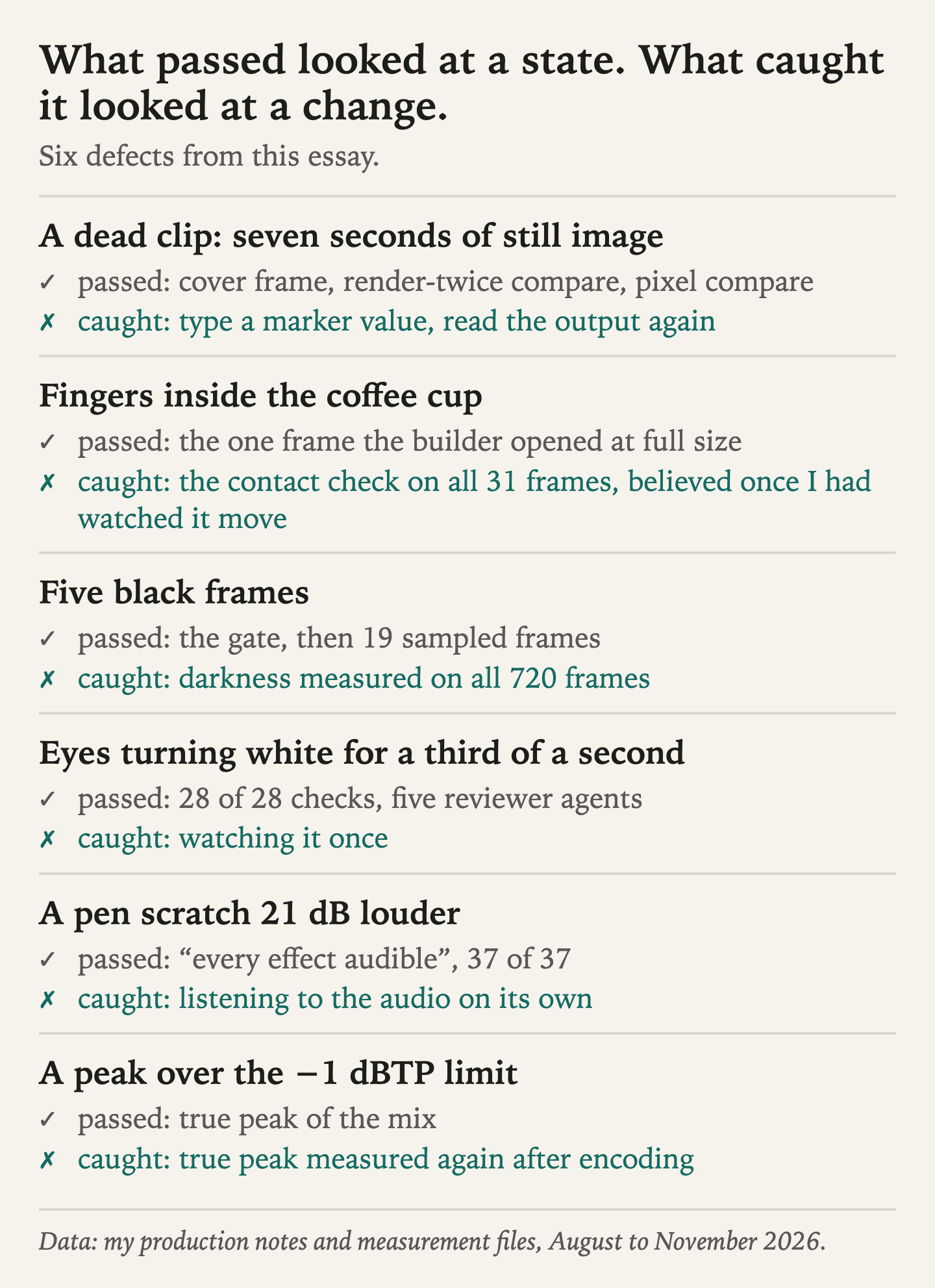
Tap to enlarge.
So my checks have changed. A motion spec now names a verb, a reason, a minimum size and one moment in which something flips. Black or frozen stretches are measured on every frame; taste is judged on samples. Every audio rule has a ceiling as well as a floor and runs on the delivered file. A story meets the cheapest picture first, read by someone who has not seen the script. When a measurement disagrees with a good-looking still, somebody plays the motion before anyone calls it a measuring error. A publish call that ends in "unknown" gets read, never resent. And the first playable cut now reaches me before the agents have judged it for several rounds.
Other people building video with code agents end up in a similar place. Dustin, who writes about making videos with Claude Code and Remotion, wrote in April that, while placing overlays on a screen recording, "no matter what I tried, the overlay position was never right". Letterboxing and scaling had shifted every coordinate. What fixed it was a thin strip cut out of the rendered frame with FFmpeg and read row by row. The coordinates had been worked out from the recording. The strip measured them.
If you want the frame and audio checks without writing a line of code, FFmpeg ships filters for them. My agents built their own checks, but these two commands get you most of the way. The first lists every black stretch in the delivered file and every freeze longer than two seconds; the second prints its integrated loudness and true peak:
ffmpeg -hide_banner -i final.mp4 -an \
  -vf "blackdetect=d=0.03:pix_th=0.10,freezedetect=n=0.003:d=2" -f null - 2>&1 \
  | grep -E "black_start|freeze_start"

ffmpeg -hide_banner -i final.mp4 -af ebur128=peak=true -f null - 2>&1 \
  | grep -E "^ +(I|Peak):"
And somebody watches it, sound on, before it goes anywhere. Thirty seconds. It is the cheapest check I have. Every daily episode reaches me as a playable video on the approval card before I tap approve, and none of the defects in this essay reached an audience. They cost me earlier, in rounds the agents judged before anything reached me. When the coffee-cup animatic reached me in round five, the fingers were in my first reply. Watching caught the hand, the eyes and the music, each time late, because I ran it last.
Nothing Escalated has posted daily since 11 November, eleven episodes in two series. The coffee-cup film is not out yet. When it is, it will have passed one more check: I will have watched the hand.
How I counted: figures come from my production notes, measurement files and review records, 1 August to 21 November 2026. "Blind" means the reader saw the picture without the script; the 22 comparisons and all scores are AI judges in internal tests, not audience reactions. Tokens are Claude tokens as logged per step; I added them within a stage, never across stages, because the logs overlap. Episode counts come from my posting log on 21 November. External: "gameability" of physics judges for video, NeurIPS 2026 workshop poster; FFmpeg's AAC encoder source; EBU R 128 (2023).
