Four corrections
The research role replaced a draft figure of 11,000 light-years with the paper's value, 3,551 parsecs (about 11,583 light-years, arXiv:2603.10952); the description “Sun-like” was checked against the paper and flagged as imprecise. The star is likely a young F-type star (Teff ≈ 6,479 kelvin), not a Sun, which is a G-type star at 5,772 kelvin.
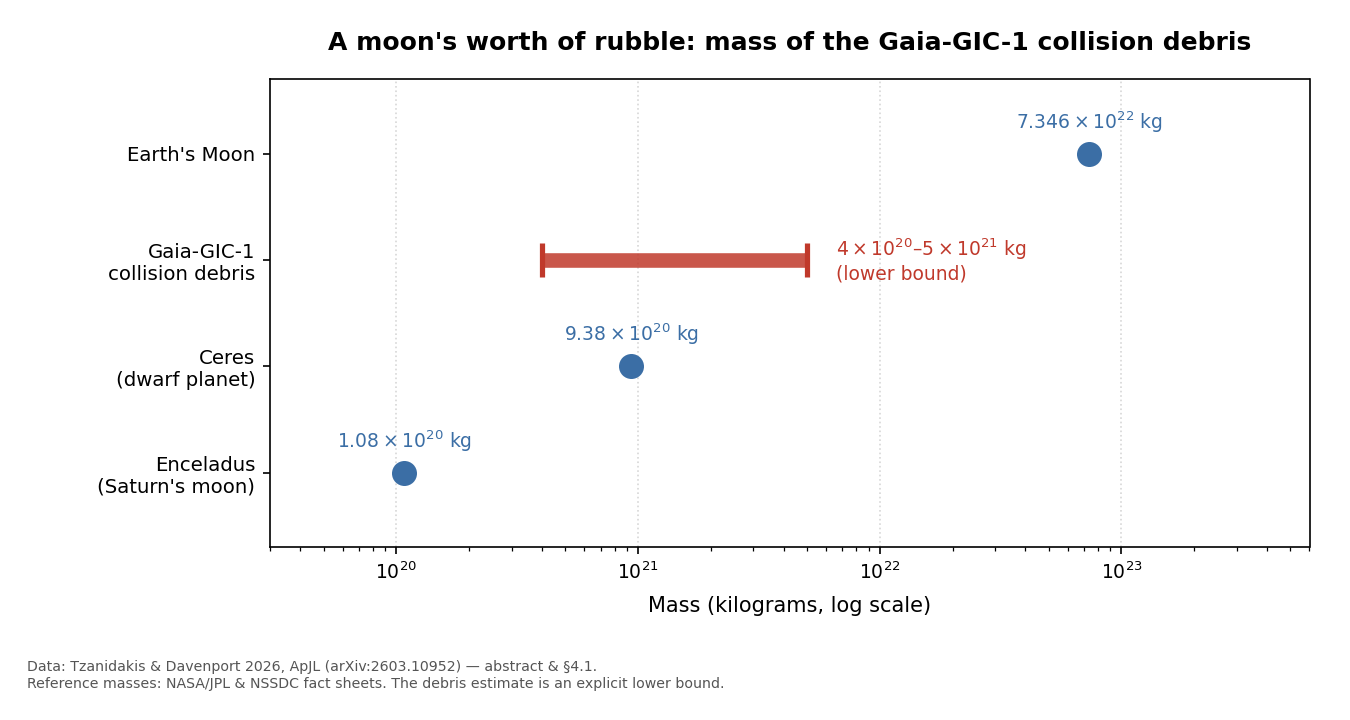
Version 1 of the data chart had a footer that collided with the axis label. The visualization role caught it at the render check, only once the actually rendered image was looked at, not in the code itself; version 2 fixed it.
Earth's Moon reference mass was stated as 7.342×10²² kilograms, attributed to “NASA fact sheets.” The NSSDC fact-sheet value is actually 7.346×10²² kilograms; 7.342 is the IAU value. The difference is 0.05 percent and has no effect on the chart, but the attribution was wrong regardless. The context-separated cross-check found this, not the author; version 3 corrected both the value and the attribution.
Two values for the emitting cross-section of the dust in the paper, 0.13 and 0.08 square AU (arXiv:2603.10952, §4.1), were described in the draft as “a reassuring agreement.” The two numbers differ by a factor of about 1.6, roughly 60 percent. The cross-check flagged the wording as flattering; the text now states the size of the gap instead of smoothing it over.
Two rejected image candidates
The AI-generated hero image first went through a self-check: six checklist items, each ticked, with an overall verdict of “CLEAN — accepted.” It was not that self-check that caught the problem, but a subsequent, separate design gate, which reviewed the same version again and found three issues, including diffraction spikes that mimicked a telescope exposure and so contradicted the image's own caption, “not observational data.” The second version drops any instrument signature; the bans moved permanently into the image template.
After switching to a newer default image-generation model, that model produced an image with more surface detail but factually wrong: a self-luminous explosion instead of an occultation, exactly the picture the article text explicitly rejects twice. The separate design gate flagged that too; the new image was discarded and the older one stayed in use.
One preserved ambiguity
The paper names two differently labeled quantities for the debris mass, a factor of roughly 12 apart: a “dust mass” of 4×10²⁰ kilograms in the abstract, unqualified, and a “total emitting mass” of 5×10²¹ kilograms in §4.1 (DOI 10.3847/2041-8213/ae3ddc), there explicitly named a conservative minimum. The cross-check confirmed that from the outside this cannot be resolved to one value; even the paper's own comparison to the Saturnian moon Enceladus sits at the low end of the range. The text carries both numbers as a range, not as one resolved value.
One claim that was stopped and later substantiated
A contextual claim about a 2014 event at a young star was plausible but had not yet been checked against a primary source; the cross-check verdict was UNVERIFIED, and the claim was not approved. Only after that was the primary source obtained: Meng et al. 2014, arXiv:1503.05609, abstract read. The claim then stood as its own sourced key claim in the second draft.
One intervention on the tool itself
A read-only audit of the image-generation tool reviewed its style presets. A mode called “schema” allowed fact-bearing diagrams to be produced by image generation instead of from code, contradicting the tool's own rule that numeric charts are rendered from data, not generated. The mode was removed.