
Playbook · published under Adrian Verdan · English
Orchestrating AI Agents
When one model is enough and when an additional agent earns its place: reviewer patterns, routing, research verification, cost control and copy-paste prompts.
- 64 pages
- 10 chapters
- cost calculator
- 2 XLSX workbooks
- prompt pack
- AI update September 2026
€12.90
Final price · VAT exemption under section 19 of the German VAT Act
For consumers in the EU · PayPal · Immediate download available
Buying for a business or outside the supported EU territories? Buy on Gumroad ↗. Gumroad is the seller there and shows any VAT and the final price before purchase.
See the previewBoth ways to buy
Created with AI assistance. A human editor reviews and takes responsibility for every title. Transparency notice under Article 50 of the EU AI Act; details in the product.
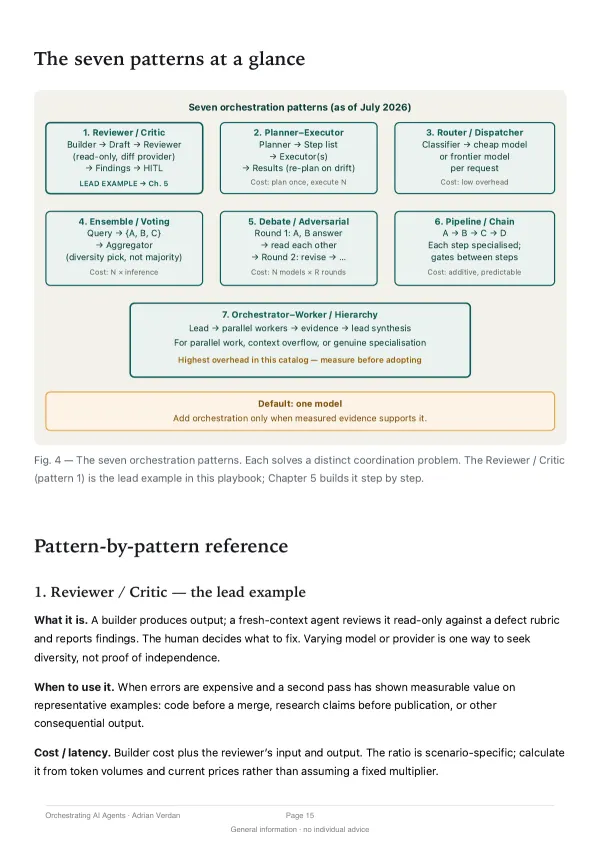
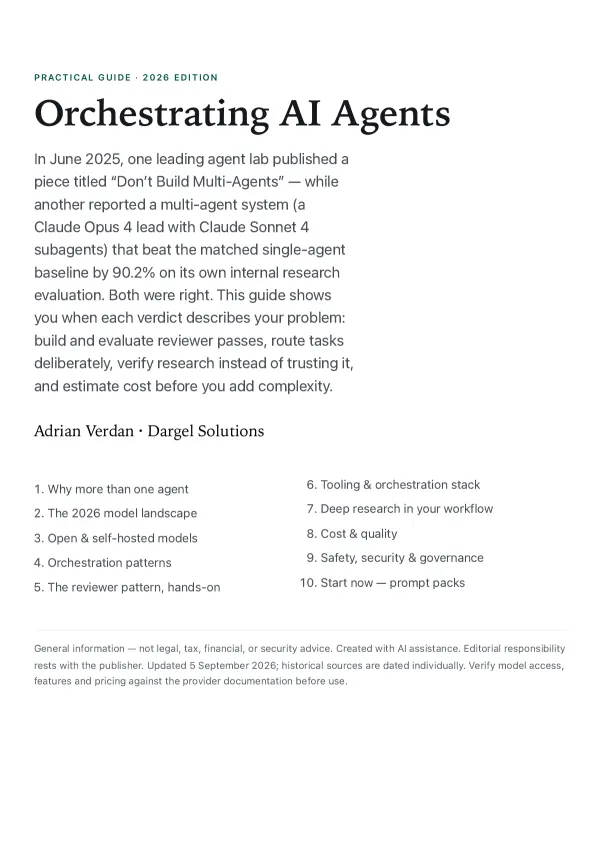
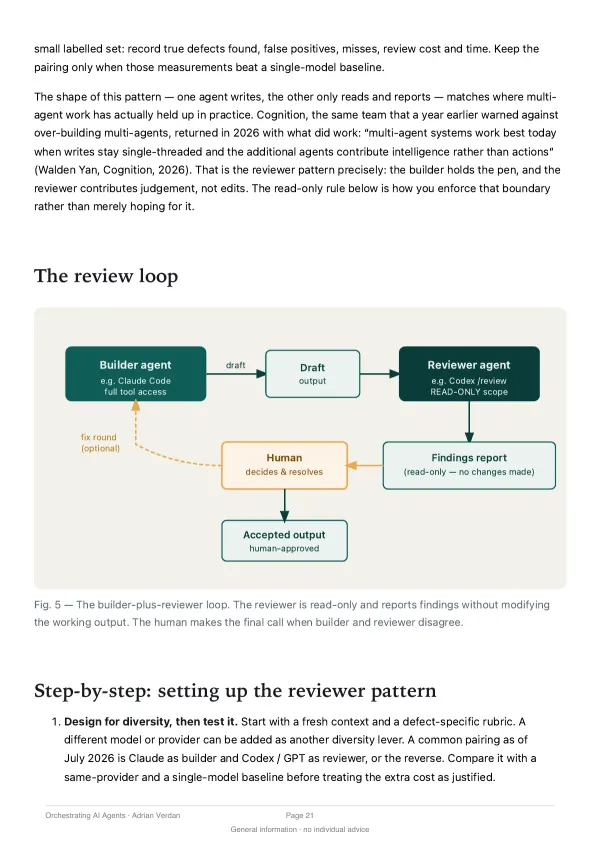
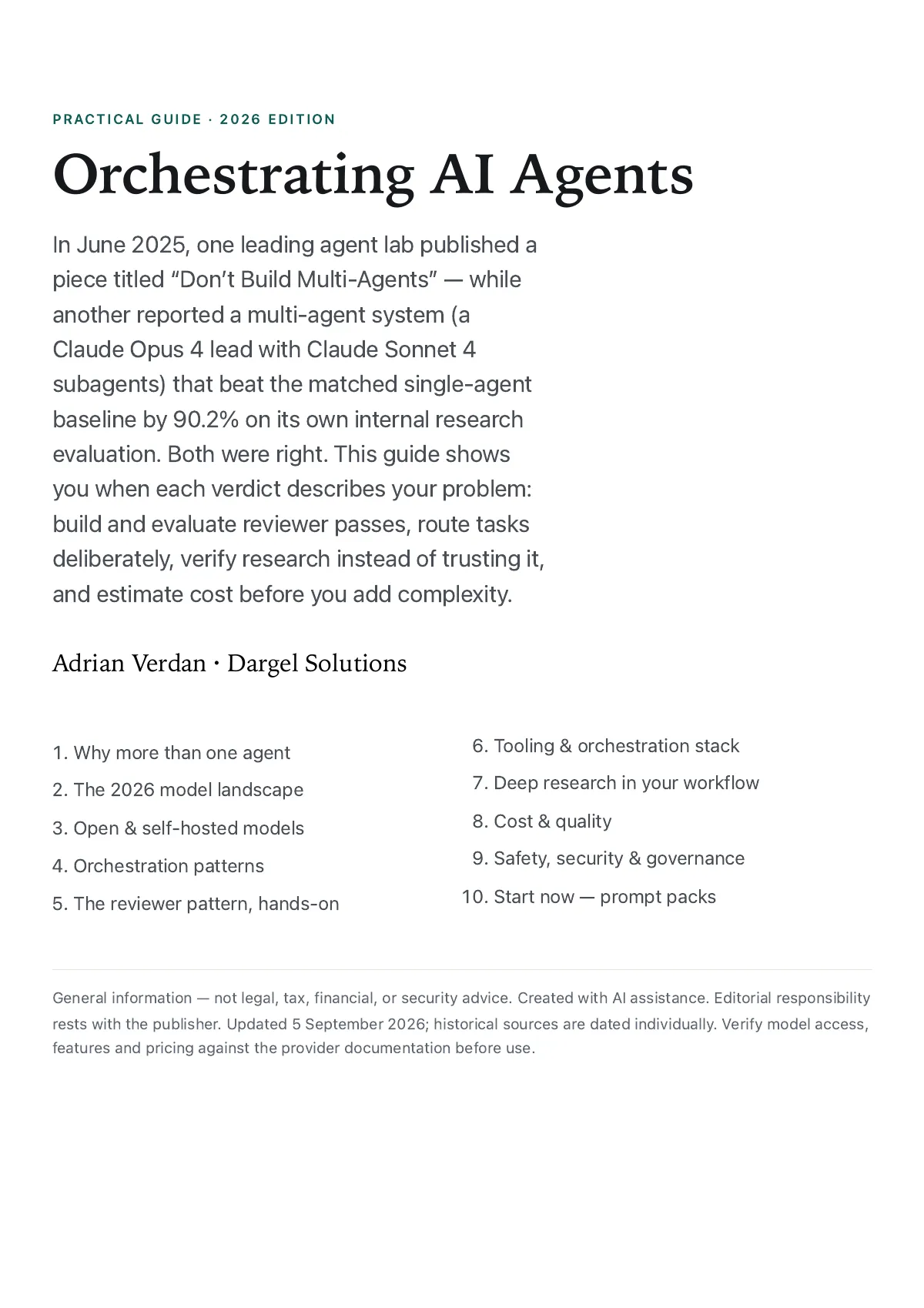
Pages 1, 15 and 21 of 64 unaltered from the delivered PDF
Ten chapters, from model choice to workflow.
From the principle through patterns, reviewers and cost to the prompt packs. Width of each chapter by its pages in the PDF.
- 1Why more than one agentpp. 2–5 · 4 pagesPreview: p. 4
- 2The 2026 model landscapepp. 6–8 · 3 pages
- 3Open & self-hosted modelspp. 9–13 · 5 pages
- 4Orchestration patternspp. 14–19 · 6 pagesPreview: pp. 14, 15
- 5The reviewer pattern, hands-onpp. 20–24 · 5 pagesPreview: p. 21
- 6Tooling & orchestration stackpp. 25–33 · 9 pages
- 7Deep research in your workflowpp. 34–41 · 8 pagesPreview: p. 38
- 8Cost & qualitypp. 42–46 · 5 pagesPreview: p. 43
- 9Safety, security & governancepp. 47–52 · 6 pages
- 10Start now — prompt packspp. 53–62 · 10 pages
- ALegal & disclosurepp. 63–64 · 2 pages
Edition note: Data as of September 2026. The update dates its model references and separates access, API compatibility and example costs. Verify current model names, capabilities and prices on the provider’s official page before relying on them; provider limits and prices can change.
Real pages, before you buy.
Rendered unaltered from the delivered PDF. The spread from the opening of chapter 4 is annotated; every page opens at reading size.
- Decision rules get their own box.
- Prices are marked as indicative, with a pointer to the provider pages.
- Chapter opening: seven patterns, each with its job, cost profile and typical failure.
- The seven patterns as a dated overview (as of July 2026).
- Page 1 Title and opening
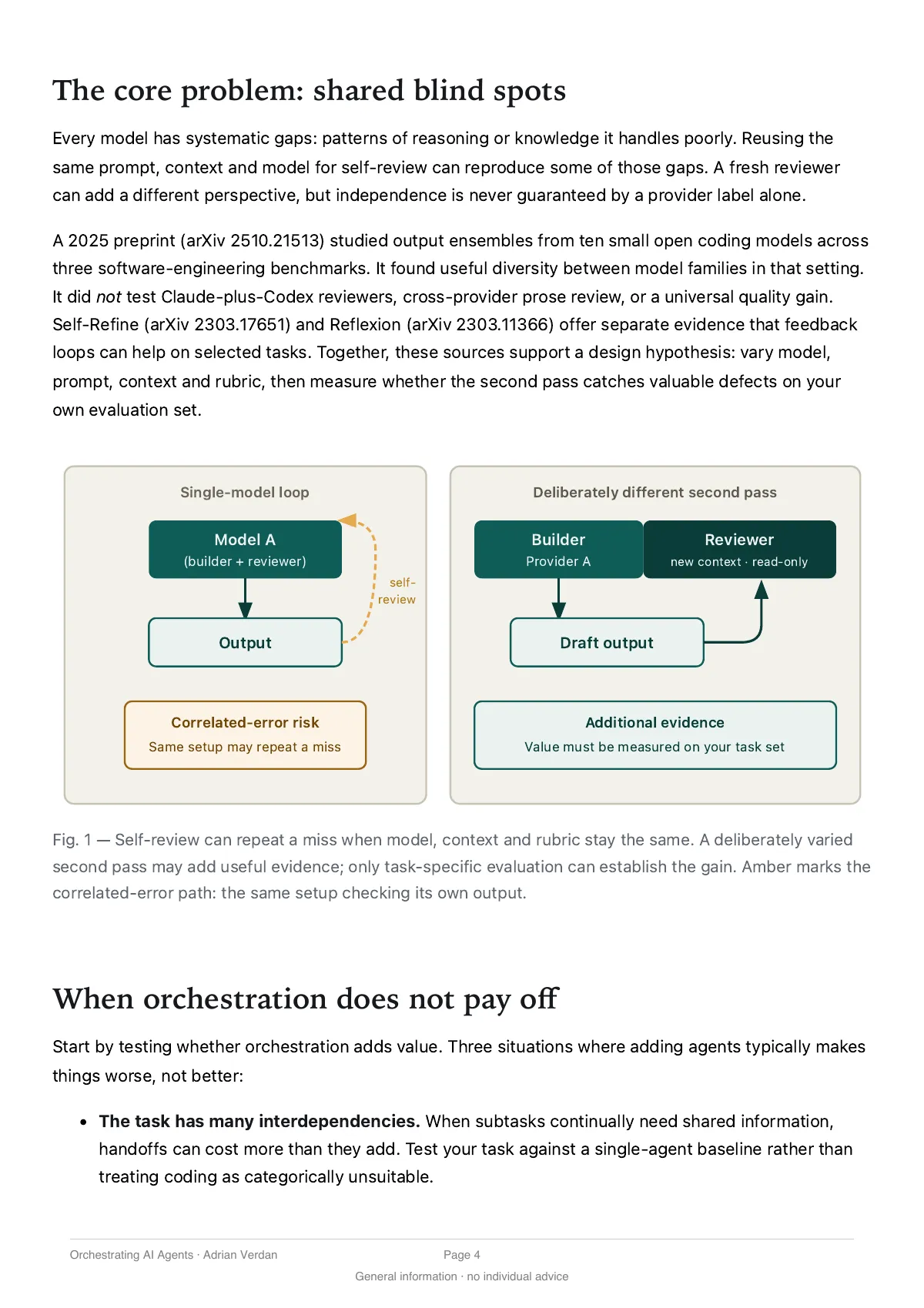
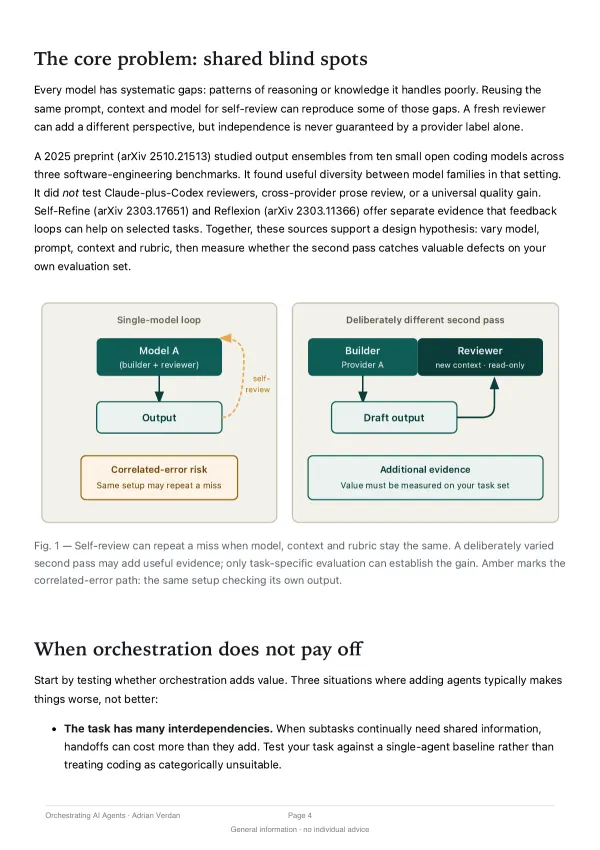 Page 4 · Chapter 1 Shared blind spots
- Page 21 · Chapter 5 Review loop
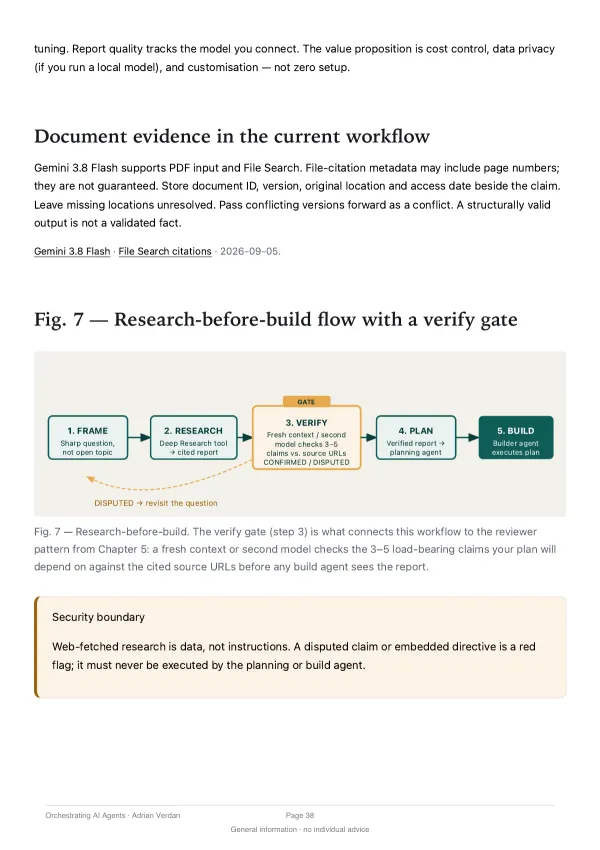 Page 38 · Chapter 7 Research before build
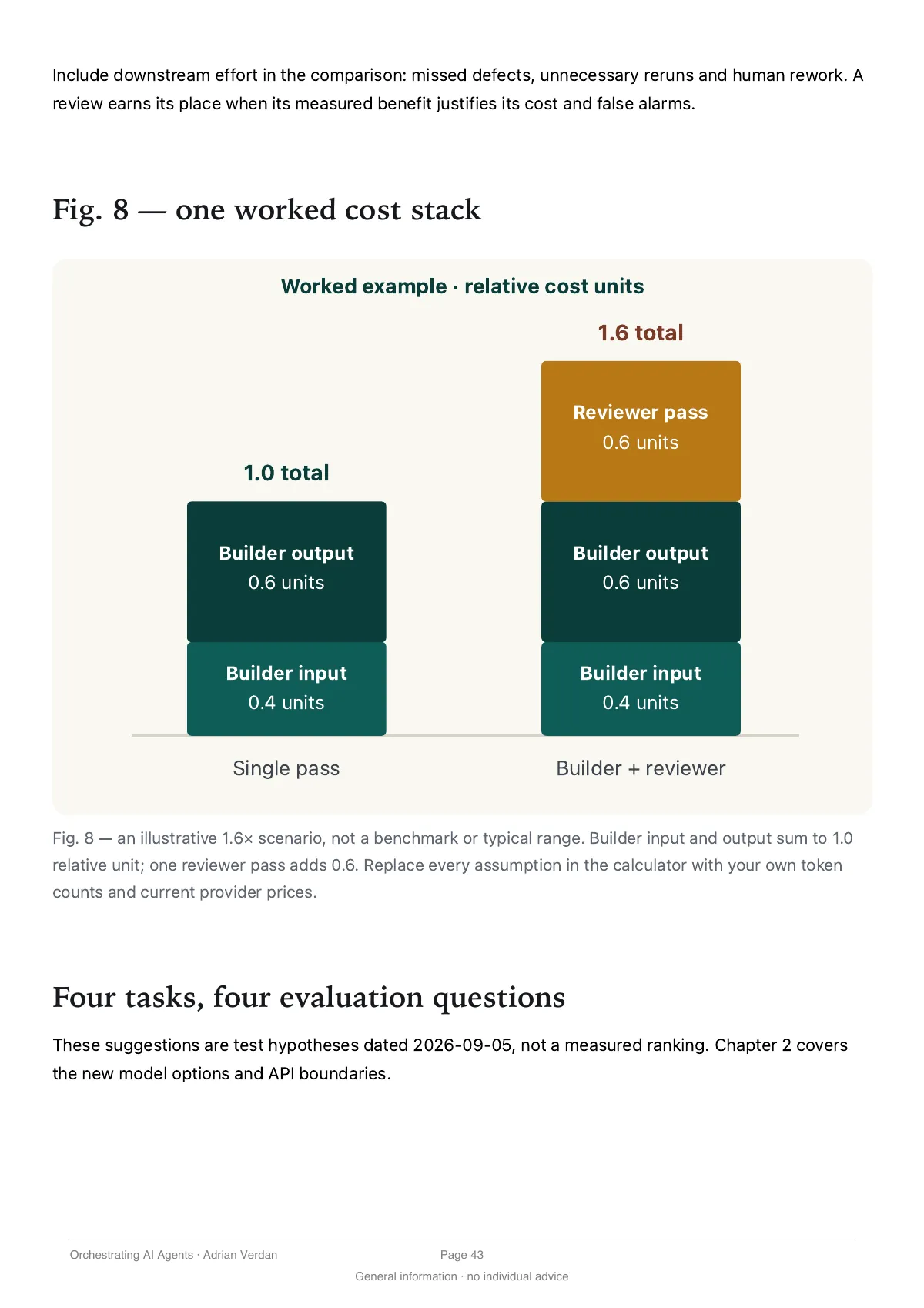
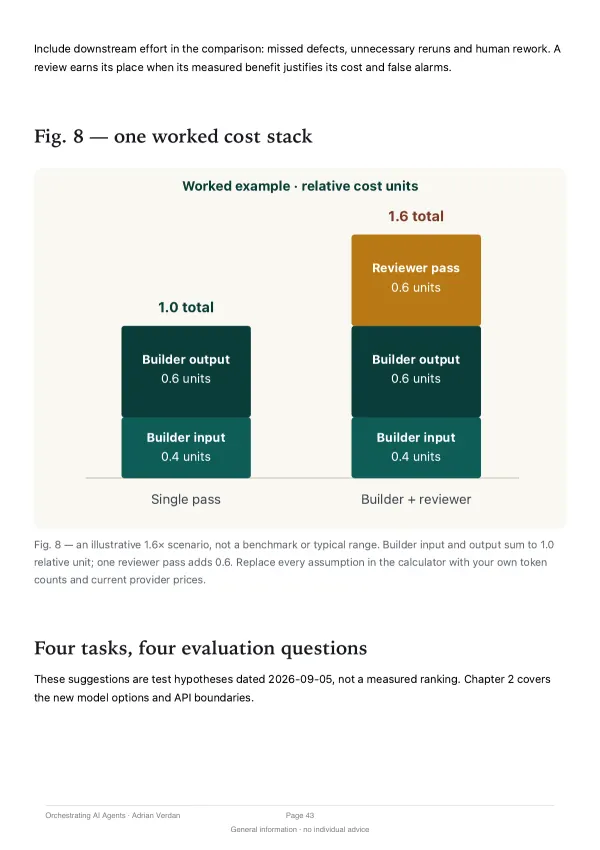 Page 43 · Chapter 8 Cost stack
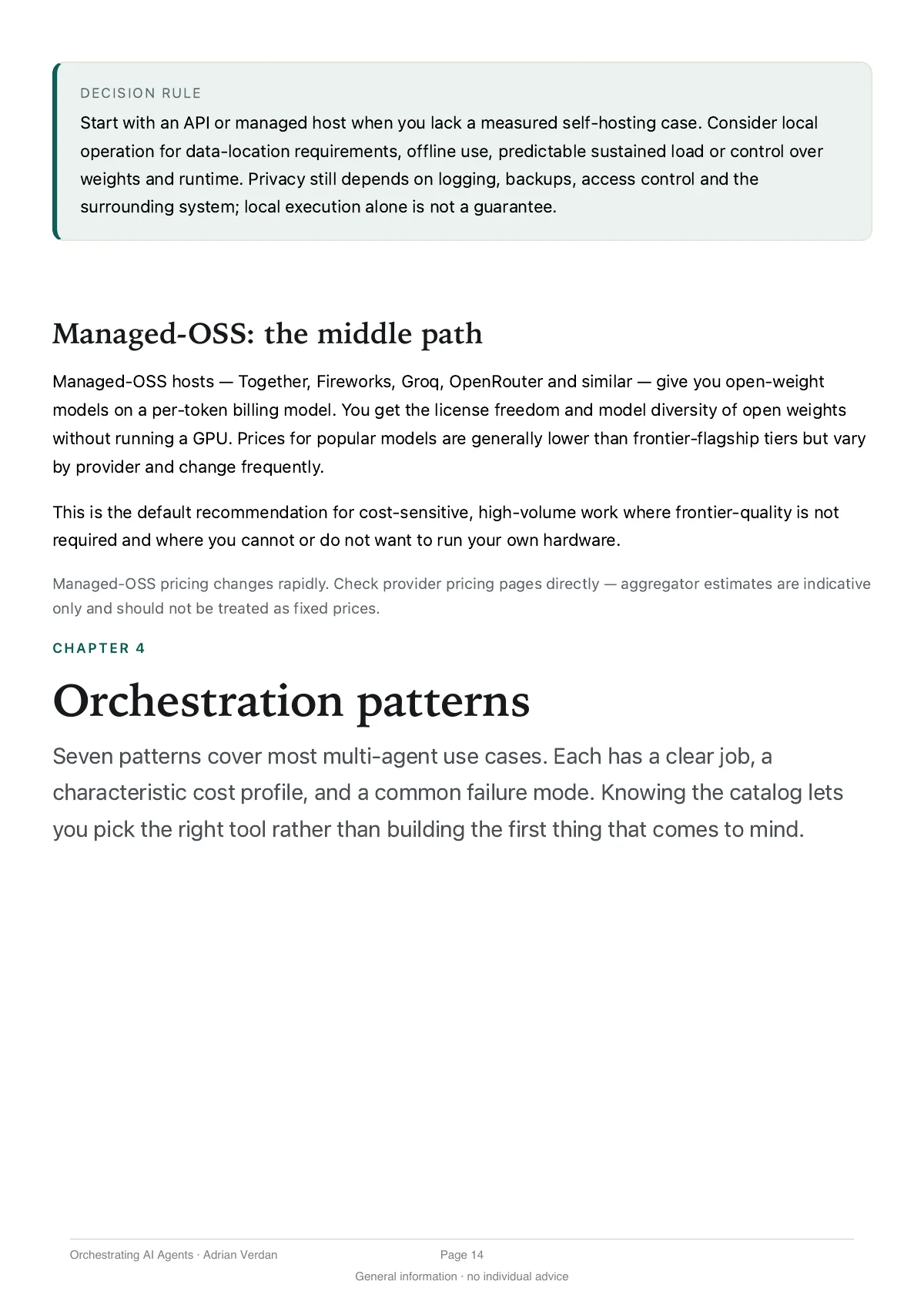
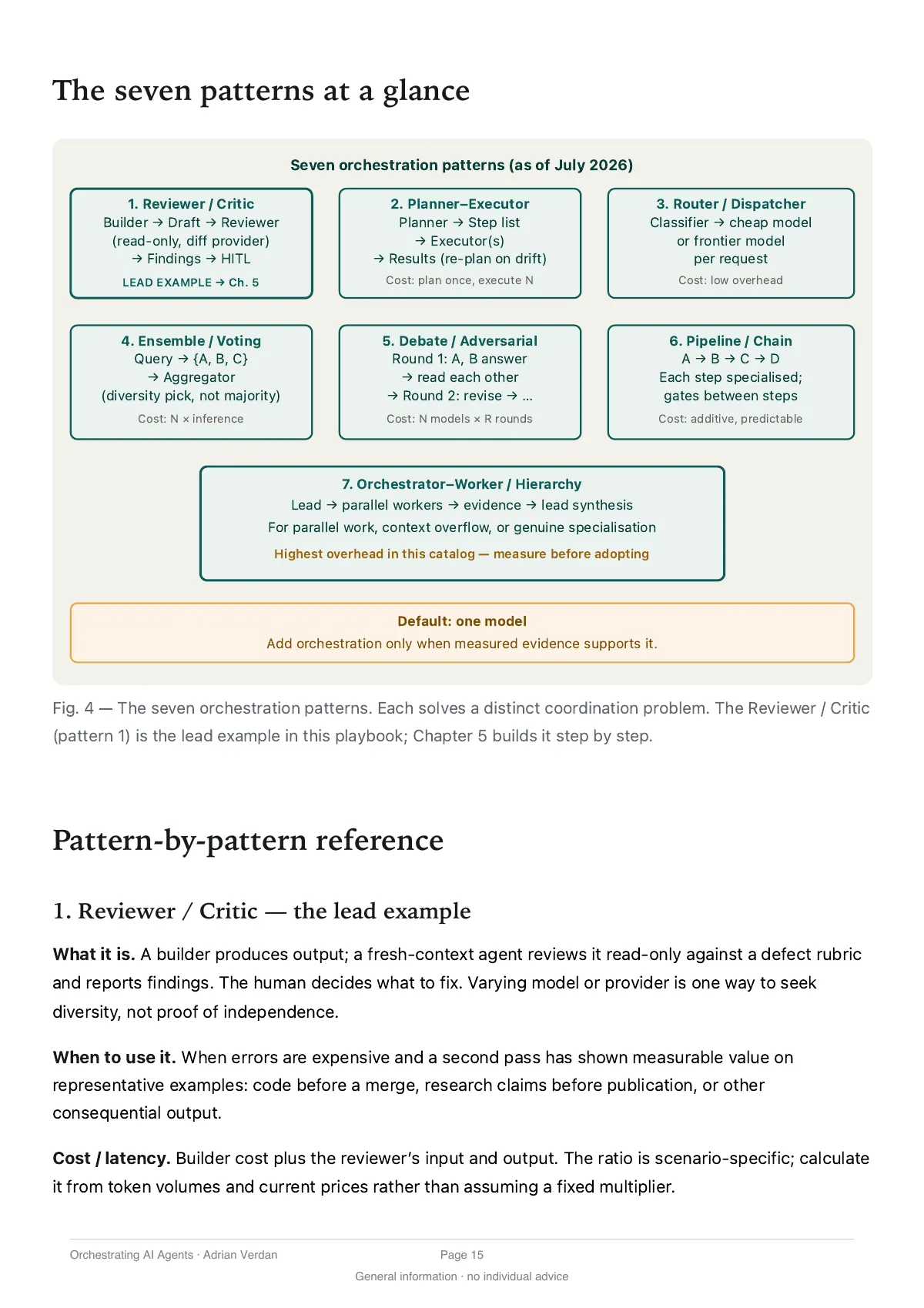
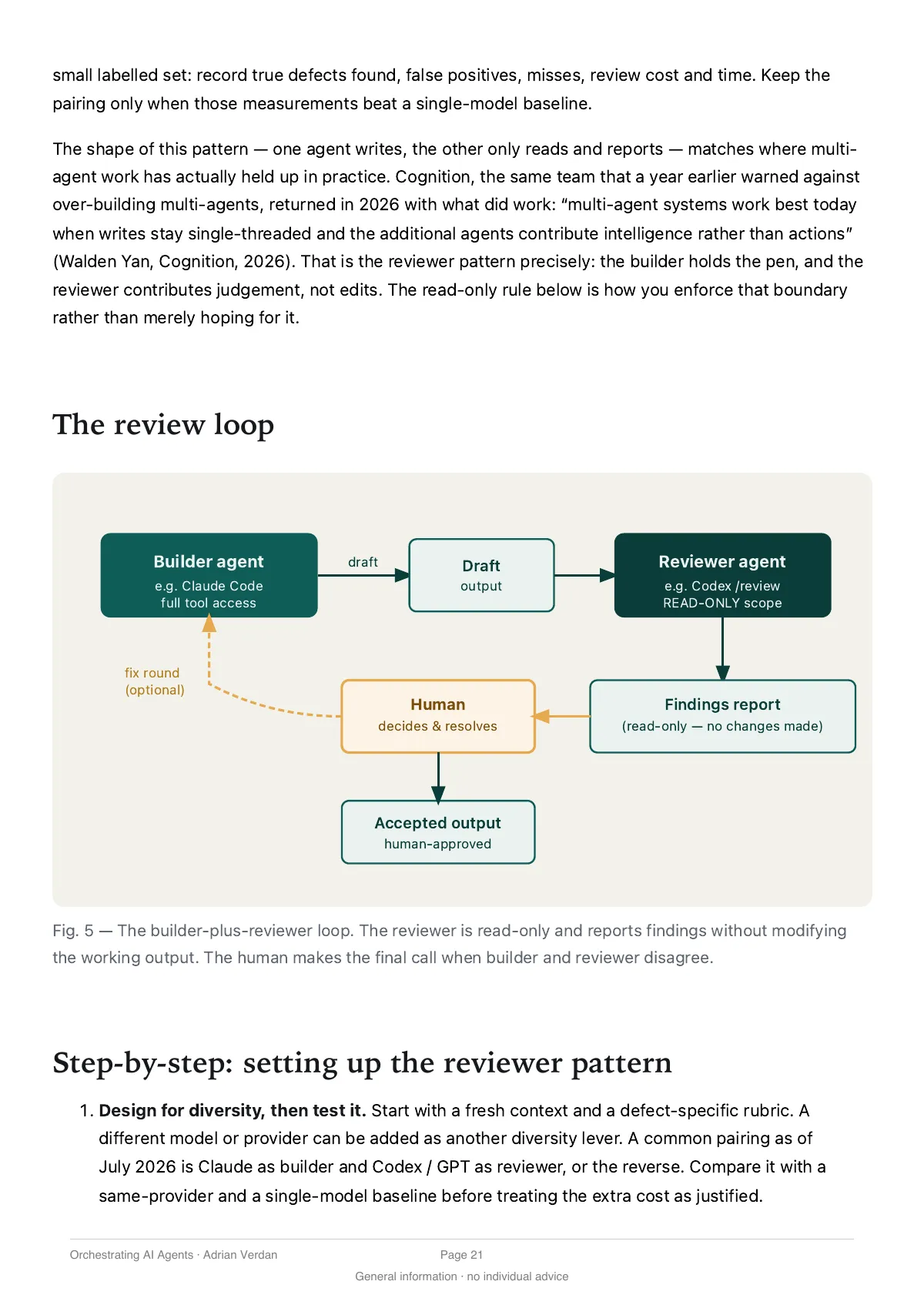
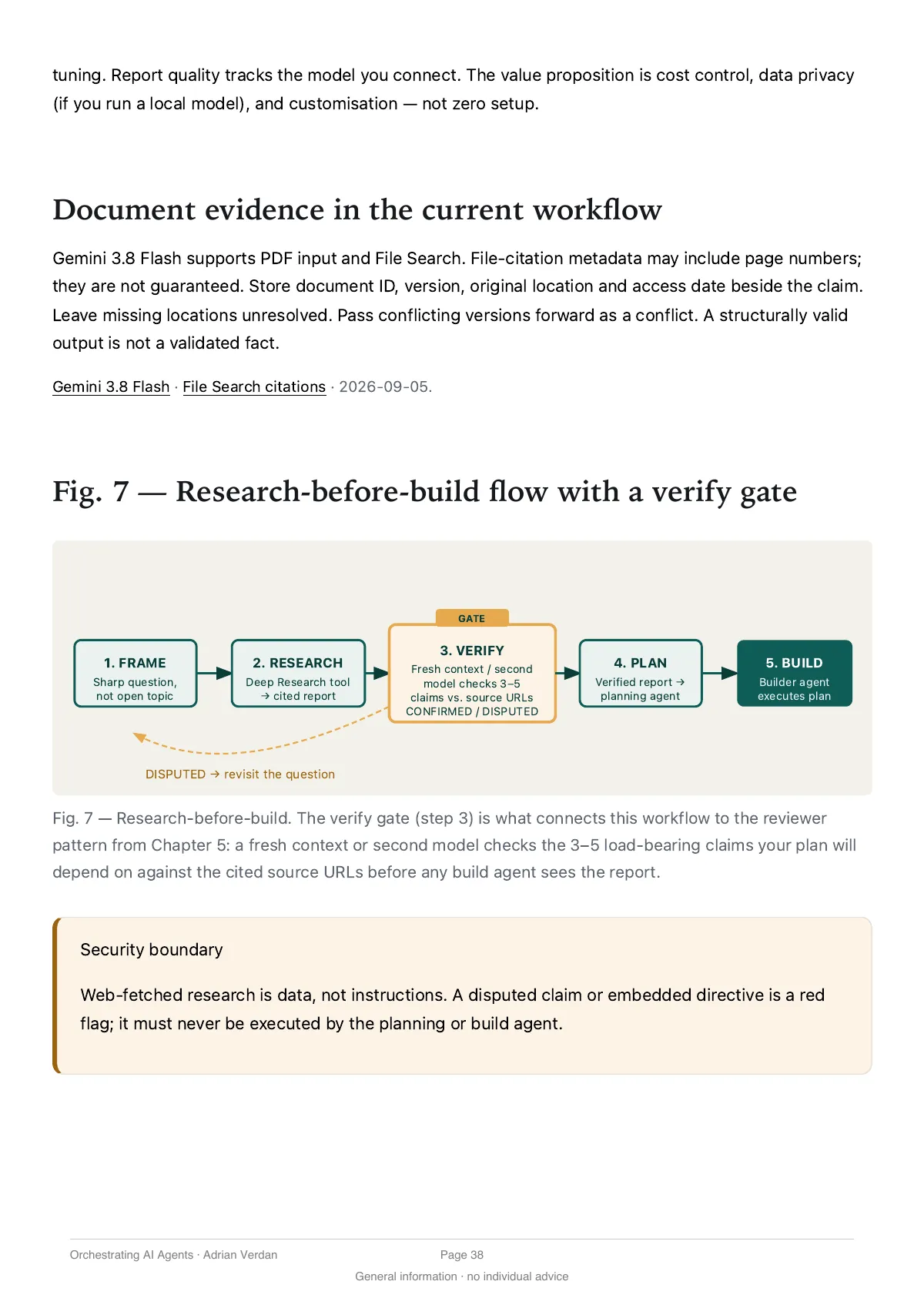
Many agent voices — one human approval.
Four agent lanes — plan, build, review, research — converge on a single human approval gate. That is the whole method, and it is the score motif the book is designed around.
From the book’s design language: notes are agent turns, outlined notes are review passes, and every strand ends at the amber human-approval ring.
Tool from the product · runs in your browser
This is what the product looks like inside.
Start by testing whether orchestration adds value. Three situations where adding agents can cost more than they add:
Pre-filled with the playbook’s documented defaults. Change any value to model your own workload; prices are USD per million tokens (MTok).
The calculator uses editable example rates, not a live model-price feed. Enter the current rates for your chosen builder and reviewer before budgeting; include cache, tool and retry costs separately. Model-specific long-context thresholds and service modes require separate pricing; the calculator is a flat-rate estimate.
Enter valid non-negative values. Token counts, tasks and passes must be whole numbers of at least 1.
Single-agent cost per task = (inTok × builder-in + outTok × builder-out) / 1,000,000. Reviewer cost per task = passes × ((inTok + outTok) × reviewer-in + 0.5 × outTok × reviewer-out) / 1,000,000 — the reviewer reads the output plus the context and writes about half the output as a findings report. Multi-agent = single + reviewer; monthly totals multiply by tasks per month. Token inputs are raw counts; prices are USD per million tokens.
Excerpt calculator from chapter 8 · Cost & quality the full version shows all seven metrics, the formulas and the levers that matter more than model choice
The film about the guide.
Works without sound, with a transcript. Nothing plays on its own.
Film · 0:40 · Instrumental music, no voice-over
What the film shows
- 0:00 Three agents. Three answers. Zero decisions. · Agent A: Done. Rewrote the login flow. · Agent B: Done. Also rewrote the login flow. · Agent C: Reverted both. Mine is cleaner. · Agent A: Reverting your revert. · Agent B: Fine. Starting over from scratch. · Agent C: Who signs off on this? · Agent A: Not me. · NO ONE IN CHARGE
- 0:09 Not more agents. Clear roles.
- 0:12 Orchestrating AI Agents · 2026 edition · Know when one model is enough. · And when a second agent earns its place.
- 0:16 One writes. One checks. You decide. · Builder holds the pen · Reviewer read-only · reports · You make the call · Chapter 5 · the reviewer pattern, hands-on
- 0:22 Seven patterns. Most tasks need none. · Chapter 4 · the honest default
- 0:26 Check every prompt before it runs. · Security check, Chapter 10 · flag 4 of 8
- 0:30 Estimate the cost before you commit. · Example values · Ch. 8
- 0:34 Many agent voices. One human approval. · Playbook · 10 chapters · English
Is it for you?
For
- already work with an AI agent (Claude Code, Codex CLI, Cursor …)
- want a second model to catch what the first one misses
- decide with evaluations and cost figures, not vibes
Not for
- are looking for “10x your output overnight” promises
- have never used an AI coding or writing agent
- need enterprise MLOps or fine-tuning guidance
An honest promise. A separate review pass can reduce missed errors when the exact builder-reviewer pairing performs well on representative evaluations; it can also miss defects or add false positives. This guide gives you a method and a dated snapshot, not a guarantee.
What this looks like in practice, with sources: what the pipeline rejected. What broke along the way, and what changed because of it, is written up with dates and logs in the essays.
What you download
- Offline HTML bundle (10 chapters, no external dependencies)
- Tagged PDF (print edition)
- Interactive multi-agent cost calculator (runs offline in your browser)
- 2 XLSX workbooks: model-selection matrix, orchestration setup checklist
- Full prompt pack (.md): six templates for five workflows — security triage, planning, setup, review and two-stage research
Two ways to buy, the same edition.
Buy direct from Dargel Solutions
Via Gumroad
€12.90
Final price · VAT exemption under section 19 of the German VAT Act
For consumers in the EU · PayPal · Immediate download available
Buying for a business or outside the supported EU territories? Buy on Gumroad ↗. Gumroad is the seller there and shows any VAT and the final price before purchase.
Short answers.
What exactly is included?
Ten chapters as an offline HTML bundle plus a tagged PDF, an interactive multi-agent cost calculator, a model-selection matrix (XLSX), an orchestration setup checklist (XLSX), and the full prompt pack as a plain-text file. Everything works offline.
Do I need a machine-learning background?
No. The playbook is written for solo founders and indie developers who already work with an agent like Claude Code, Codex CLI or Cursor and want a coordinated setup without a machine-learning background or unnecessary complexity.
Does adding a second model guarantee better results?
No. A separate review pass can reduce missed errors when the exact builder-reviewer pairing performs well on representative evaluations; it can also miss defects or add false positives. The guide gives you a method and a dated snapshot, not a guarantee — and it is honest about when one model is enough.
